

Integrating WordPress into Headless CMS architectures has become one of the most popular practices for developing content and digital experiences, due to the need for high performance, flexibility and front-end independence. Leveraging solutions such as Strapi and Contentful allows organizations and businesses to operate WordPress as a component in a larger multi-tier architecture, in which content is produced or processed in Headless environments and distributed to websites, applications and multi-channel systems. This particular approach is being developed due to the advantages it offers in performance, scalability and data integrity.

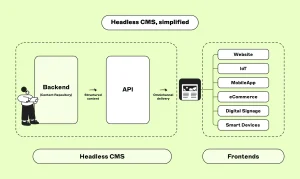
Introductory overview of the Headless philosophy
Headless CMS is defined as a content management system in which the presentation engine and the content engine remain separate. This philosophy is implemented in WordPress through the use of the WordPress REST API or GraphQL (using WPGraphQL), allowing content to be consumed by any front-end framework without relying on traditional theme-based rendering.
By integrating CMSs like Strapi and Contentful, multi-source content management is possible, in which different data categories are created or hosted outside of WordPress, while WordPress remains as a management or complementary platform. This architecture is particularly useful for organizations that require high consistency, central governance, and cross-channel delivery.
Role of WordPress in a Headless Environment
In Headless systems, WordPress is not used as a traditional CMS with themes, but as a back-end API provider. In this form, functionality is limited to the production, management and export of content via API, while the display is transferred to external systems that manage the performance, interaction and architecture of the pages.
Η επιλογή του WordPress ως component ενός Headless συστήματος βασίζεται στην ευρεία υποστήριξη, την ωριμότητα, τη δυνατότητα αξιοποίησης εκατοντάδων plugins για επέκταση λειτουργιών, καθώς και τη χαμηλή τεχνική απαίτηση για συντήρηση. Η χρήση του WordPress ως “content entry panel” αποτελεί συνήθη πρακτική σε επιχειρησιακά μοντέλα στα οποία η ομάδα περιεχομένου είναι εξοικειωμένη με το WordPress και δεν επιθυμείται η πλήρης μετάβαση σε νέο CMS.
In such implementations, WordPress acts as either a primary or secondary content source, while Headless CMSs act as a central data manager or as middleware that takes care of structuring, modeling, and categorizing content in a more standardized framework.
Role of Strapi and Contentful in multi-tier architecture
Strapi is an open-source Headless CMS based on Node.js, allowing for high customization, automation, and integration with third-party systems through an API-first design. Its architecture allows for customization of content-types, workflows, and validation rules, with the ability to automatically create REST and GraphQL endpoints. It is widely used in environments where development depends on extensive customizations and where the back-end logic requires high flexibility.
Contentful, on the other hand, is an enterprise-grade SaaS Headless CMS that focuses on scalability, stability, and structured content model management. It offers advanced governance tools, localization, high-level API rate limits, and a permissions system suitable for enterprise environments with multiple teams. It is often used in multi-channel digital platforms, as well as in organizations that require strict standardization and controlled content delivery.
The coexistence of WordPress with Strapi or Contentful allows the creation of a hybrid structure in which content of different types is managed by different CMSs, depending on the needs, capabilities and limitations of each system.
WordPress Integration Models – Headless CMS
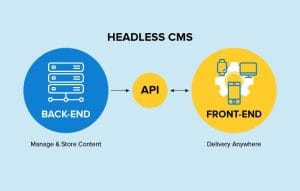

Three basic integration models are identified:
1. WordPress as primary CMS and Strapi/Contentful as auxiliary CMS
In this format, WordPress retains the primary role of content production, while Strapi or Contentful act as complementary platforms for specific data categories, such as dynamic components, product schemas or structured content. The front-end simultaneously makes requests to WordPress and the Headless CMS to render a full page.
2. WordPress as API layer and Headless CMS as main content hub
In this form, the central content modeling is done in Strapi or Contentful, while WordPress is used as an interface for the content team. The Headless CMS acts as an authoritative source and synchronizes data to WordPress, which is then used only as an API server for front-end frameworks.
3. WordPress and Headless CMS as parallel standalone sources
This implementation is used in complex applications where the front-end consumes data from multiple endpoints. In such systems, WordPress and the Headless CMS operate independently, without synchronization between them, and the front-end takes care of the data aggregation, formatting, and rendering.
Each model is selected depending on operational needs, the structure of the organization and the desired level of automation.
WordPress as a Headless API Architecture
Running WordPress in a Headless environment requires disabling traditional theme rendering, which is achieved by using a minimal theme or by removing the need for a theme altogether. Content is rendered via REST API endpoints such as /wp-json/wp/v2/posts/, /pages/, /media/, /menu/ or via GraphQL schemas when using WPGraphQL.
In this way, WordPress acts as an API repository that delivers content to front-end applications. It does not perform rendering, does not manage UI, and does not assume visual control of the user experience.
This approach requires the existence of caching mechanisms such as Redis, Varnish or Nginx microcaching, as well as the appropriate configuration of permalinks, security headers and CORS policies for the secure and efficient delivery of data to the front-end.
Strapi's function as a modeler and API orchestrator
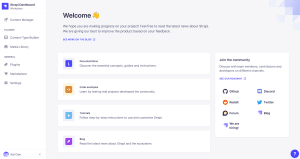

Strapi is often used as a data modeler when strict structure, validation, and synchronization of content across multiple systems are required. In WordPress implementations, Strapi acts as an intermediate layer that handles more complex content-types, such as custom entries, multi-relational data models, or datasets that are not natively supported in WordPress.
Strapi creates endpoints that are consumed directly by the front-end or used to transfer data to WordPress. Using Strapi allows for workflow automation, custom logic implementation, and microservices development that enrich the functionality of the entire system.
Contentful's operation as an enterprise content hub
Contentful is used when the business requires multi-channel content, multilingual structure, advanced permissions and content governance. Its integration with WordPress relies on the capabilities of API delivery and management SDKs that allow content routing to and from WordPress.
The Contentful–WordPress architecture is often used when WordPress serves as the administrative interface, but Contentful is the authoritative system that provides the final content. This way, the ease of use of WordPress is combined with the stability and structure of Contentful.
WordPress integration with Strapi or Contentful via API
The interconnection is achieved through the following techniques:
- REST API consumption, in which WordPress acts as an API provider and Strapi or Contentful act as a client or reverse-proxy that receives, processes or reconstructs content.
- GraphQL schema federations, in which Strapi, Contentful and WordPress expose GraphQL endpoints that are combined into a unified schema, allowing the front-end to receive data in a unified manner.
- Webhooks and event-driven synchronization, during which changes to WordPress or Headless CMS trigger automated synchronization processes.
- Middleware integration, where server-side scripts act as connectors that integrate content, resolve conflicts, and apply transformation rules.
These specific techniques are utilized based on the application requirements and the desired data consistency.
Functional advantages of combinatorial architecture
Using WordPress together with Strapi or Contentful offers numerous advantages in business environments.
Content management flexibility is significantly enhanced, as different types of content can be supported on different platforms, avoiding the limitation of a single system.
Front-end application performance increases due to the ability to leverage frameworks such as React, Next.js, Vue or Svelte, which operate independently of WordPress. This eliminates the rendering issues of traditional WordPress and achieves a significant improvement in loading speed.
Scaling is achieved more efficiently because any part of the architecture can be upgraded without affecting the other. WordPress can be scaled as an API-only system without the need for front-end load management, while Strapi and Contentful can operate in a distributed environment.
Security is enhanced due to the isolation of the UI layer, the ability to implement stricter permission models, and the absence of traditional WordPress theme attack vectors.
Furthermore, the development experience is significantly improved, as back-end and front-end teams can work independently, with completely different tools and pipelines, without time dependencies.
Challenges and limitations of hybrid architecture
Despite the advantages, the combination of WordPress and Headless CMS brings challenges in terms of maintenance, consistency, and technical complexity.
The need to manage multiple API endpoints necessitates a clear design and data integration mechanisms. The multi-tiered architecture creates increased requirements for debugging, monitoring and logging.
In environments with STRAPI or Contentful as primary systems, synchronization with WordPress requires mapping, transformation, and validation processes to avoid differences in field structure.
Security becomes more complex as multiple platforms require independent authentication and authorization mechanisms, as well as rate limiting, CORS, and API key rotation policies.
API performance can be affected by large payloads, unoptimized queries, or the absence of caching layers, requiring constant monitoring and tuning.
Finally, reliance on third-party Headless systems may create subscription costs, as well as API quota limitations, especially in high-traffic environments.
Integration with front-end frameworks
The combined use of WordPress and Headless CMS fully supports the development of modern front-end applications such as Next.js, Nuxt, Astro, Remix, Gatsby and other frameworks. The front-end takes care of data retrieval via API and page rendering in SSR, SSG or ISR modes, while optimizing performance and user experience.
Using WordPress as a REST API provider allows the utilization of pre-rendering and caching mechanisms, while the Headless CMS offers structured data models that support dynamic and component-based architectures.
Conclusion
Combining WordPress with Strapi or Contentful creates an advanced multi-tiered architecture that allows businesses to manage content with greater flexibility, security, and performance. The hybrid WordPress–Headless CMS architecture provides scalability, reliability, multi-channel delivery, and collaborative development capabilities that are not possible with traditional systems.
It is increasingly used in organizations that require high quality, systematic content management and presentation independence, allowing the development of modern web and mobile experiences with a stable and coherent database.
For the implementation of Headless CMS architectures, WordPress integration with Strapi or Contentful, as well as the development of custom API layers, comprehensive solutions are provided by the team. Fixit.gr, with the ability to analyze requirements, design and technically implement customized infrastructures for business environments.