Introduction
Until now, your eShop has been designed for one visitor: the human. Eye-catching photos, click-bait buttons, an offer in the right place. That doesn't change. It simply stops being the only thing that counts.
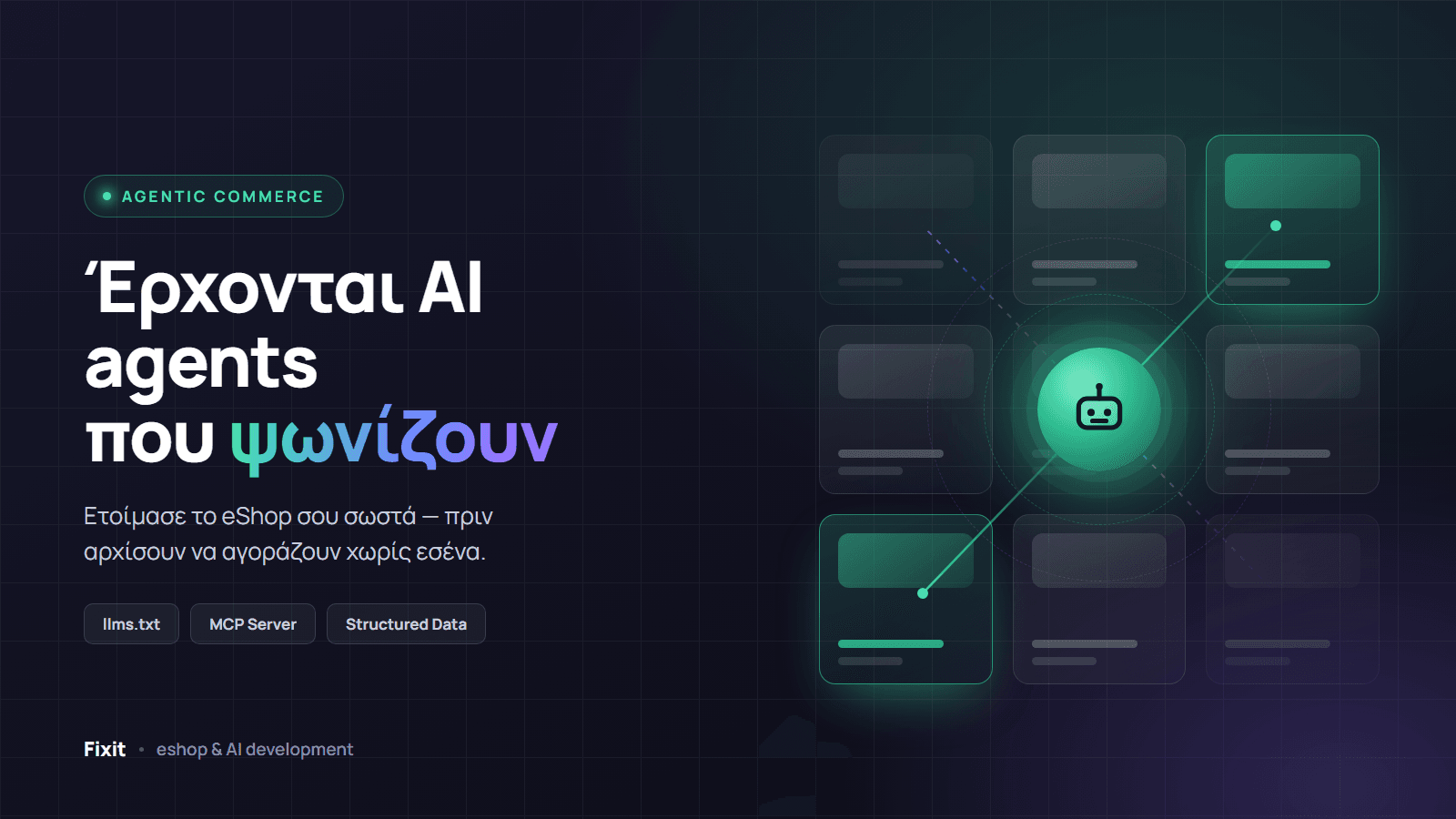
Alongside humans, a second visitor has begun to enter: an AI agent that searches, compares, and increasingly completes the purchase on someone's behalf. It doesn't see your banner. It doesn't scroll through the category. It reads data and responds to its user with a suggestion. Or three. And the question for every eShop is simple: will you be among the three?;
It's not something you "have to buy." It's something that, just as we all learned at some point to make our site mobile-friendly and then fast, now we just have to get it right. All of us.
What does "agentic commerce" mean in practice?
Agentic commerce is commerce where part of the journey to the market is done by an AI agent instead of the consumer themselves. The user no longer types «white sneakers» into a search engine and opens eight tabs. He types something like «find me white sneakers size 42, under 90 euros, delivered by Friday» and waits for a response.
The agent then does the same job that the human did before: searches, compares, filters, rejects. The difference is that he has the patience of a hundred stores and zero tolerance for ambiguity. If he doesn't find a clear answer to "is it in stock", "how much does it cost with shipping", "when will it arrive", he doesn't insist. He moves on to the next store.
And here's the pain point: an eShop can have an excellent user experience and at the same time be almost invisible in this process. Not because it's doing anything wrong, but because all the information the agent needs is locked away in the design — in tabs, in popups, in images, in texts that load with JavaScript after the click.
The coming future of advertising
The biggest change isn't technical, it's advertising. For twenty years we've been paying to get someone's attention: a spot in the results, a banner, a video before the content. The model was based on a simple assumption — that there's someone on the other end looking.
But when an agent takes on the intermediary role, attention ceases to be the commodity. The agent is not impressed by creative. He does not click out of curiosity. He chooses based on how clean, complete and reliable your data is in relation to the competition. The «advertisement» to an agent is the quality of your information.
This does not mean that Google Ads and Meta Ads are over — on the contrary, humans remain the final decision-maker and will continue to see ads. But it does mean that a second channel is emerging, in which you do not enter with a budget but with preparation. And as with any new channel, those who enter early pay less and earn more. In the Greek market at the moment, almost no one is prepared. It is the phase where the advantage is still free.
Why the agent doesn't "see" your products
The most common objection we hear is: «but I already send feeds to Skroutz and Google Shopping, my data is there.» True, but only up to a point.
The feed answers another question. An XML feed says «this is the product, this price, this EAN.» It doesn’t say who you are, what warranty you offer, how a return works, what your shipping policy is, why a product fits a specific need. The agent needs both layers: the data and the context.
The information is scattered. Shipping terms on one page, return policy on another, actual stock in an ERP that doesn't communicate with anything. The human puts it all together with difficulty. The agent, if he doesn't find it all together, simply ignores it.
The design hides the data. Price that only appears after selecting a variant, availability that loads dynamically, features in an image instead of text. What is beautiful to the user may be empty to the machine.
The three levels of preparation
The good news is that you don't need to rebuild anything. You just need to properly display what you already have, on three levels.
First level — structured data. Proper schema.org on every product page: price, currency, availability, manufacturer, code, reviews. It’s the most boring step and the most crucial, because it’s the only language that all systems already understand. If you have WooCommerce or Magento, the basics are there — what’s almost always missing is accuracy: stock that doesn’t match reality, prices without VAT, variants that aren’t declared.
Second level — llms.txt. A simple Markdown file at the root of your domain that acts as a map: who you are, what you sell, where the important pages are, what your terms are. We have to be honest here, because there is a lot of exaggeration going around: Google has publicly stated that it does not use it in search and it is not a ranking trick.. No one should be putting it in expecting a boost in results. Where it really works is in the tools that read documentation to answer — and the cost is an hour of work. It's cheap readiness, not a magic wand.
Third level — live connection. The level that makes the difference. A static file does not know if the product was sold ten minutes ago. An MCP server, i.e. a standardized connection point on top of your eShop and ERP, allows the agent to ask at that moment: is it available, what is the price for this customer, when is it delivered to Thessaloniki. This is where the theory stops and the real market begins.
Where most eShops go wrong
The most common mistake is not inaction, it's rushing in the wrong direction: putting a chatbot in the corner of the page and thinking that the "AI" topic is covered. The widget serves your own visitor. It doesn't make you visible to agents working outside your site.
The second mistake is data that doesn't agree with each other. One value on the page, another in the feed, another in the ERP. The human will ask. The agent will kick you out, because inconsistency translates into unreliability.
The third, and most dangerous, is letting AI systems guess for you. When they don’t find clear information, they don’t always keep quiet — sometimes they fill in the blanks with incorrect information. An inaccurate «does not ship outside of Attica» or a price from last year is worse than obscurity.
What to do this week
You don't need a six-month project. You need a clean start.
First, make sure your structured data is accurate and up-to-date on price and availability. Gather the information that every shopper asks for in one place — shipping, lead times, returns, warranty — and write it in plain text, not in images or popups. Add an llms.txt with realistic expectations. Make sure price and stock tell the same story everywhere. And then, if your store has volume and a complex catalog, consider live linking via MCP.
None of these moves are wasted even if agent adoption is slow. They are the same moves that make your eShop cleaner for search engines, more consistent for customers, and easier to maintain.
That's the essential argument. We're not setting ourselves up for a promise. We're getting our data in order — which we should have done anyway — and at the same time we're ready when the next channel opens. Ads will still speak to people. It's just that, increasingly, someone else will have already made the choice before they see them.
At Fixit we help eShops on WooCommerce and Magento get ready for this part: structured data, llms.txt, MCP connection to ERP and private AI agents that work on your own data. If you want to see where your store is today, we can check it together.