Black Friday doesn't disappear in November. It disappears in August, when no one cares about it.
In November, all you have time to do is run after whatever breaks. Now you have time to set it up. And the part that almost everyone leaves for last — even though it's what determines how many orders will be completed — is support.
What really breaks down on peak day
Everyone talks about the server. The server is the easy part: you measure it, you test it, you upgrade it.
What's really falling apart is human support. The volume of questions doesn't go up proportionally with traffic — it goes up more, because Black Friday brings in a disproportionate number of people. new visitors who don't know you. They don't know your return policy, they don't know how much shipping is, they don't know if they'll have time to get it by Christmas. And they ask.
At the same time, your team is busy with orders, the warehouse, and suppliers. You know the result: messages that go unanswered for two hours, phones that don't get answered, and carts that are abandoned not because the price was wrong, but because no one answered the "will I make it?" question.
The same ten questions, five hundred times
If you look at last year's Black Friday messages, you'll see a pattern. The vast majority are variations on the same questions:
Where is my order?; When does it leave, when does it arrive, because I don't have tracking yet.
Is it available in this size/color?; The stock changes throughout the day and the page doesn't have time to convince them.
How much does shipping cost and when do you deliver?; The most frequently asked question before completing an order — and the most expensive if left unanswered.
Does the discount apply to this? Is it combined with the coupon?; On Black Friday, pricing rules become complicated and the customer doesn't trust what they see.
What if it doesn't work for me?; Returns, changes, deadlines.
None of them need a human. They all need correct answer, immediately. .That's exactly the difference.
Why a generic chatbot widget won't save you
This is where most eShops make the mistake. They put a ready-made chat widget in a week in advance, connect it to a generic AI model, and think they've covered the support.
The problem isn't that the model isn't smart enough. It's that does not have access to your data. He doesn't know your stock right now. He doesn't know what stage order 14872 is in. He doesn't know that this year you changed your return policy from 14 to 30 days.
And because it's built to respond, it's going to respond anyway — with something that sounds right. It's going to say, "Deliveries typically take 3-5 business days," it's going to say, "We typically accept returns within 14 days." On your busiest day of the year, it's going to give hundreds of people information that no one has ever confirmed.
A bad chatbot on Black Friday isn't neutral. It's worse than none at all, because it makes promises that you'll be asked to fulfill — or break.
What does he need to "know" to answer correctly?
The difference between a chatbot that helps and one that exposes you is one: where it gets the answer from.
A properly set up system doesn't pull answers from its general knowledge. It gets them from your own data — the product catalog with current stock and prices, the status of orders, the shipping and return policies as they apply today, the frequently asked questions that you've already answered a thousand times.
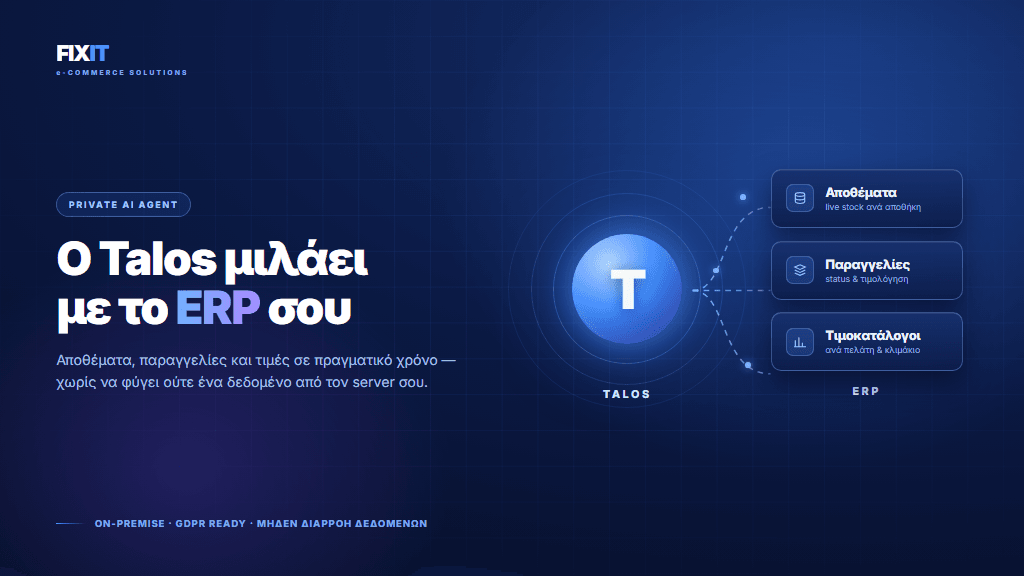
This is the logic on which the Talos: a private AI ecosystem that runs on your own infrastructure and reads your own data, instead of guessing. The data is not leaked to third parties — which, when we're talking about order and customer data at peak times, is not a detail.
The schedule: what are you doing now, what in September?
August — gather reality. Download last year's tickets and messages from the period. Categorize them. You will clearly see which five questions the 70% of the volume asks. At the same time, finally write your policies correctly: shipments, delivery times, returns, guarantees. If they are not written somewhere clearly, neither a human nor an AI can answer them correctly.
September — linked the data. This is where the real work happens: the system needs to see the catalog, stock, and order status in real time. If you have ERP, this is where it comes into the equation. This is the part that takes time, which is why it doesn't happen in November.
October — try it with real people. Let it run at normal speed. Read the conversations. You'll find questions you never imagined and answers that need fixing. This is the month that makes the difference on peak day.
November — arrangements only. You add the rules of the offer, the delivery deadlines for the holidays, and everything that only applies to those days. Nothing new.
When should a person speak?
A good system doesn't try to answer everything. It knows when to hand over the conversation.
A complaint, a cancellation request, a payment issue, a lost package, an angry customer: these go to a human, with the entire conversation history included so the customer doesn’t have to tell their story all over again. The value of automation isn’t in getting your team out of support — it’s in freeing them up for exactly the ten conversations that are truly worth their time.
How will you know if it worked?
Don't look at how many conversations took place. Look at three things: how many conversations were closed without a human being being needed, how much the average first response time decreased during peak hours, and — most importantly — what percentage of conversations resulted in a completed order.
Keep the questions that were left unanswered. It's the best list of improvements anyone will ever give you, and it's free.
The preparation checklist
Now: extracting past questions and categorizing them; writing up-to-date shipping and return policies; checking that product data is consistent across the board.
Until the end of September: connection to catalog, stock and order status; rules for delivery to a person; clear what is allowed to say and what is not.
Until the end of October: testing in real traffic; reading conversations and making corrections; checking on mobile, that's where the most volume will be done.
First week of November: bidding rules and holiday deadlines; a plan for what happens if something goes wrong.
Black Friday isn't a day to try something new. It's a day to make something you've already tried work.
If you want to see what this would look like in your own eShop — what data needs to be connected and what can realistically be answered automatically — talk to us. August is just the right time for this conversation.