Introduction
When we talk about AI agents in a business, the conversation almost always goes to the same place: the customer. In the eShop chat, in tickets, in questions about orders. It makes sense — that's where the result is most easily seen.
But there is a second audience that we overlook, although it asks much more: your own team.
The people who work with you ask dozens of questions every day that never make it into any system. They ask each other. They dig through old emails. They open a folder with six versions of the same file. And when they can't find it, they ask the person who "knows it all" — who is usually the busiest person in the company.
The questions that are not recorded anywhere
Try to remember what your coworkers asked you in the last week. The pattern is almost always the same:
«What is the price for this customer — does he have a special price list?» «How do we handle a return on a product purchased on sale?» «Which supplier covered this code for us?» «What did we agree on with this customer for shipping?» «Where is the latest price file — the one we sent or the one we revised later?»
None of these are difficult questions. But they all have the same cost: interrupt two people — the one who asks and the one who answers. And the answer is usually already written somewhere. It's just that no one remembers where.
Why company knowledge doesn't live in a system
In most Greek businesses, real knowledge is not found in the ERP or the eShop. It is found in three places: in Excel and PDF files, in emails, and in the heads of two or three people.
This works up to a point. Then it starts to cost money. When the person who «knows» goes on leave, the team slows down. When a new colleague comes in, it takes weeks to learn things that are already written. When a policy changes, someone continues to work with the old one — not out of negligence, but because they had the previous version saved.
The problem is not that the information is missing. It's that it is not accessible when you need it.
What does "Talos in the team" mean?«
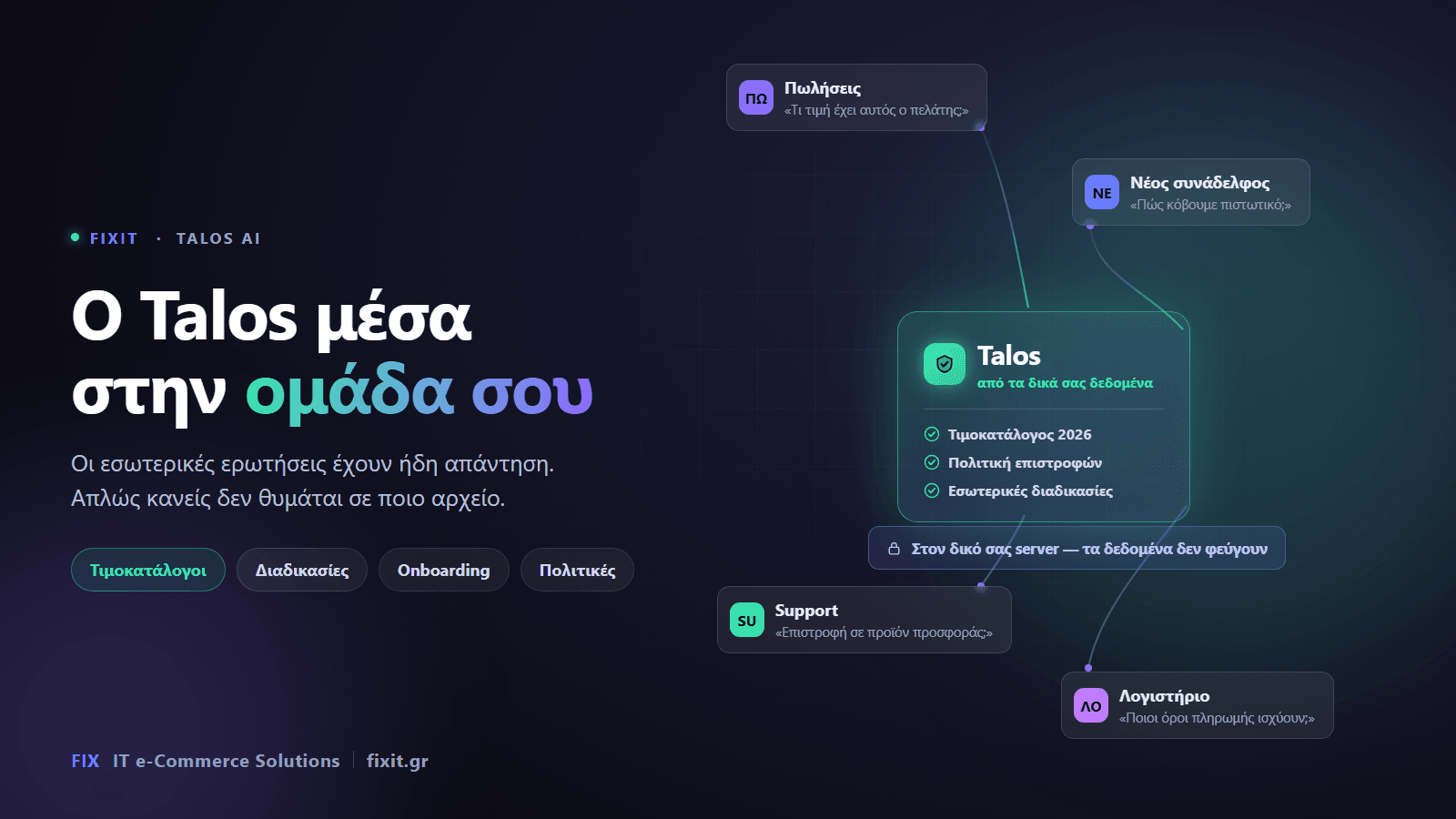
Talos is the AI ecosystem we build on top of your business. Its most well-known use is customer-facing, but the same logic works internally as well.
Instead of searching through folders, the team asks questions in plain Greek and gets answers from the yours documents and data: price lists, procedures, policies, manuals, instructions, whatever you have already written.
The difference with a generic AI tool isn’t how «smart» the model is. It’s where it gets the answer from. A generic chatbot has no idea what your return policy is — so it will tell you a policy that sounds right. That’s worse than not answering at all, because your colleague has no way of knowing that the answer is made up.
Where does it make the biggest difference?
Onboarding. The new colleague has a hundred questions in the first week and hesitates to ask half of them. When he can ask freely, he learns faster and doesn't waste the time of three people.
In sales. Special prices, discount scales, per-client agreements, payment terms. Information that changes and needs to be correct the moment you speak to the client — not half an hour later.
In support. The support team responds faster when they don't have to do internal research for every second question.
In the procedures. How do we cut credit, what do we do in case of damage in transit, what are the steps for a replacement. Written once, available to everyone, always in their latest version.
The issue that determines the decision: the data
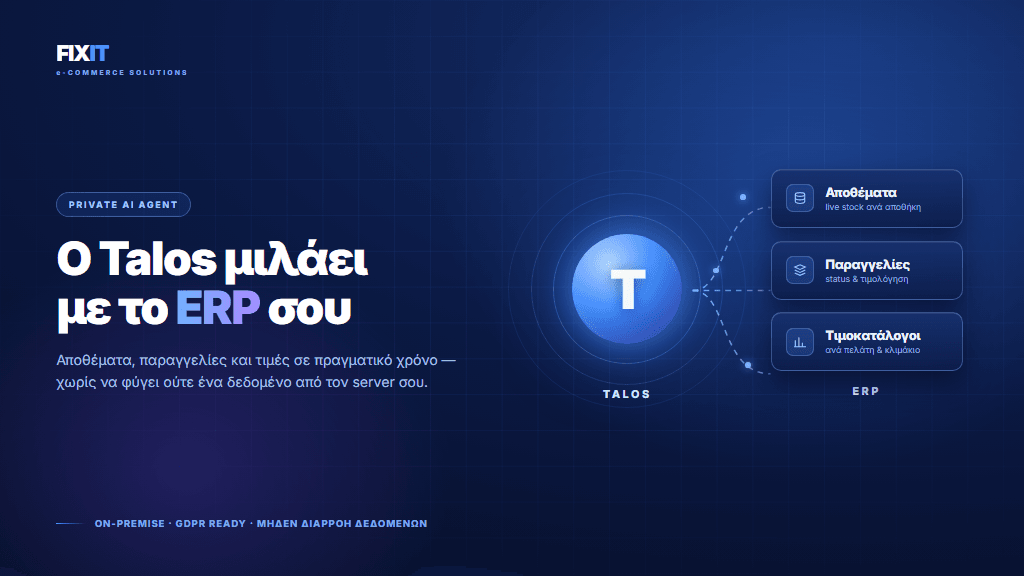
This is where internal usage differs significantly from external usage. A customer chatbot sees products and orders. An internal tool sees pricing policy, profit margins, agreements with suppliers, internal documents. That is, exactly the data you don't want uploaded to a third-party cloud service.
Talos was designed from the ground up for this: it runs on private server — yours or ours — and your data never leaves the infrastructure. No external model is trained on it and no third party sees it.
It’s not a theoretical issue. It’s why many companies have already banned employees from pasting company files into public AI tools — and why they do it anyway, because they haven’t been given an alternative. Providing a safe alternative is more realistic than hoping the ban will be enforced.
It's not just for eShop
This is perhaps the most important difference in this usage. A customer chatbot assumes that you have an eShop and traffic. An internal AI tool assumes neither.
All you need is a team that asks questions and written knowledge: technical companies, service agencies, wholesalers, craft businesses, accounting and law firms, companies with many external partners. The more procedures and exceptions your business has, the bigger the difference.
How does it start in practice?
First, choose a topic, not the entire company. The most common point of friction — usually price lists or support processes.
Gather everything that is already written. You don't need to write a manual from scratch. You just need to clarify which file is the correct one and which is old.
Start with a small group. Three or four people asking real questions for two weeks immediately show you what's missing.
Keep the questions unanswered. These are the most useful list you will ever have — they show what knowledge about your company isn't written down anywhere.
What not to expect
It doesn't replace the human decision maker. It doesn't guess: if a piece of information isn't anywhere in your data, the right behavior is to say they don't know it — and that's something you should demand, not consider a weakness.
And most importantly: it doesn't fix the mess. If your procedures are in three conflicting versions, the result will show it. In practice, this proves useful — most teams discover how many things they thought were "known" when they were just verbal.
The essential benefit
It's not the speed of response. It's that knowledge ceases to depend on the availability of specific people.
A business where three people keep the critical things in mind is a business that stops every time one of them is missing. Making this knowledge accessible to everyone, securely and within your own infrastructure, is one of the few changes that are visible from the first week.
If you want to see how this would work on your own team, talk to us — we always start from a specific point of friction, not the entire company.