Creating product descriptions is one of the most time-consuming processes in e-commerce. A proper description influences the customer experience, the understanding of a product's features, the purchase decision, and the overall image of an e-shop. At the same time, the quality of the description significantly impacts organic rankings in search engines, as the text accompanying a product serves as a key SEO factor.
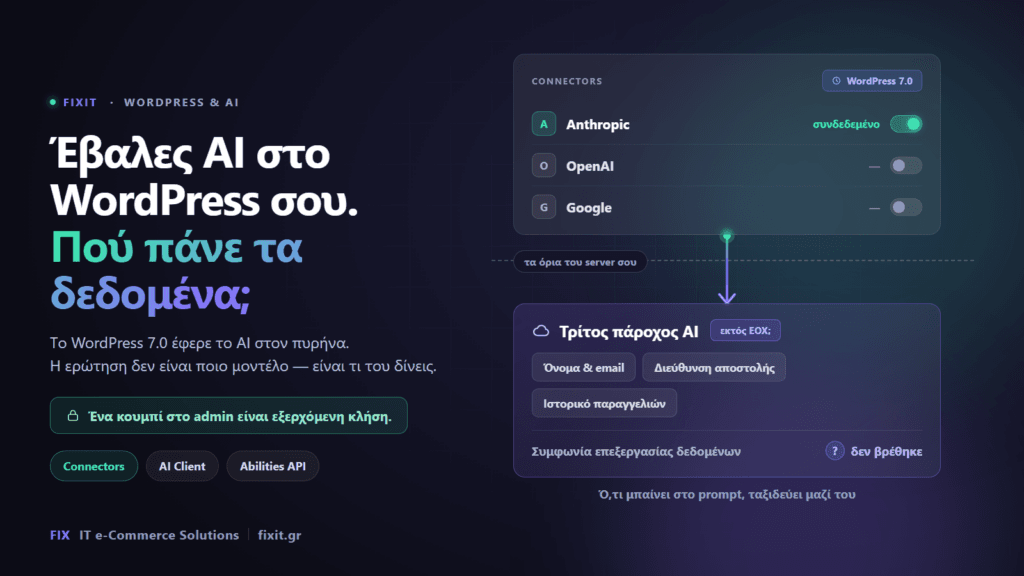
In a WordPress and WooCommerce environment, the constant need to create thousands of descriptions, update old texts, and maintain uniformity in format and tone makes the process demanding. The integration of Artificial Intelligence offers a solution to this problem, allowing for the automation of content creation via the OpenAI API. In practice, a custom AI Agent is "trained" on the products, categories, and style of the e-shop and then produces descriptions with consistency, speed, and high quality.
The purpose of this article is to present the way businesses utilize WordPress, WooCommerce, and OpenAI to automate the creation of product descriptions. It outlines the data organization process, the training of the Agent, the functioning of automated text generation, the business benefits, and the practices required for the process to operate effectively.
The importance of product descriptions in e-commerce
Product descriptions serve as the "bridge-text" between the customer and the purchase. Their value is decisive, as they determine:
- the understanding of the product,
- the perception of quality,
- the differentiation between similar products,
- customer trust,
- the purchase decision,
- the product's ranking in search engines.
In large e-shops, content creation often requires significant labor. The need to maintain a uniform tone, consistent structure, and accurate information makes the process difficult when done manually. Furthermore, frequent changes in the product catalog require continuous content updates, creating an additional workload.
In this environment, the use of automated description generation methods offers significant business value.
The concept of AI Content Automation
Content automation with OpenAI is described as the process by which product data is transformed into comprehensive descriptions through artificial intelligence. WordPress serves as the content management base, while the OpenAI API provides the capability for automated text generation. The AI Agent is "trained" to understand the products, the e-shop's tone, customer needs, and SEO requirements.
In this way, descriptions are created which:
- reflect the identity of the e-shop,
- use natural language,
- contain the necessary information,
- boost SEO,
- maintain uniformity across a thousand or more entries.
AI-powered description generation does not work through the arbitrary creation of text. Instead, it relies on the data provided by the e-shop and the overall content strategy.
The WordPress – WooCommerce – OpenAI relationship

In the business process, WordPress functions as the content management system (CMS) and WooCommerce as the product management system. The OpenAI API serves as an additional tool for automating description generation.
The collaboration of the three elements can be described as follows:
- WooCommerce provides the product data.
- WordPress hosts the environment where descriptions will be generated and stored.
- The OpenAI API creates the descriptions based on the data.
The AI Agent used in the process is trained on the tone, the products, and the commercial policy, in order to produce descriptions that reflect the company's image.
Product data as the basis for training
The way product data is presented directly affects the quality of the description. The systematic organization of elements related to the product constitutes the foundation of the AI Agent's training process.
The basic elements include:
- product title,
- category and subcategory,
- attributes,
- construction materials,
- technical specifications,
- sizes,
- colors,
- uses,
- availability,
- additional information accompanying the warranty or support.
The quality of the description depends on the quality of the data. When the e-shop provides vague or incomplete information, the descriptions become less useful. When the data is organized, the descriptions become more accurate, better structured, and more user-friendly.
Training the AI Agent on the company's tone of voice.
Training a custom AI Agent is not limited to product information. The e-shop possesses a distinct "voice"—the overall communication style used in descriptions, articles, newsletters, banners, and promotional activities. The Agent is required to learn this style to produce content that aligns with the brand.
Included in the training are:
- past descriptions,
- category pages,
- blog content
- corporate pages,
- support messages,
- user manuals,
- purchase policies.
In this way, the Agent creates content that does not feel "foreign" compared to the existing content.
The importance of content consistency.
In large e-shops, every product description created by humans inevitably shows slight variations in style or structure. Through automation, greater consistency is achieved, as all descriptions are generated based on a common set of principles. This consistency contributes to:
- in a uniform user experience,
- in a consistent brand image,
- in reading ease,
- in higher SEO quality,
- in avoiding errors or contradictions.
The stability of descriptions is considered a critical factor for large enterprises aiming to project an image of professionalism and cohesion.
Selecting the appropriate description style.
During the Agent's training, the tone that will be used in the texts is defined. The style can be:
- proffesional,
- friendly,
- technical,
- minimal,
- SEO oriented,
- Product-Centric
- Descriptive
- Simple & Direct
The choice of tone depends on the e-shop's profile and the nature of the products. For example, an electronics store requires high precision and a clear description of technical specifications. In contrast, a clothing store needs descriptions that emphasize style, look, and feeling. Finally, a home goods e-shop needs descriptions that highlight practicality and application possibilities.
The Agent adapts to these needs through training.
Content production automation
After the Agent's training, the automatic content production process is activated. This function transforms the existing data in WooCommerce into full descriptions.
The process can be described as follows:
- The Agent receives the data for each product.
- The information is analyzed and categorized.
- A first draft of the description is generated.
- The text is checked for consistency with the e-shop's commercial policy.
- The text is published or delivered for further editing by the team.
This process is carried out in seconds for each product, allowing for the rapid production of a large volume of content.
Using AI as an assistant editing tool
Artificial intelligence can be used not only for content creation but also for editing manually written descriptions. The Agent can adjust the tone, improve readability, remove ambiguities, and add missing elements.
This function allows for:
- consistency between new and old descriptions,
- aesthetic content renewal,
- SEO upgrade of legacy products,
- catalog renewal cost reduction.
Older product descriptions are given a modern format, enhancing the overall image of the e-shop.
SEO Optimization via AI

Product descriptions play a critical role in an e-shop's visibility on search engines. Through the use of artificial intelligence, the following are achieved:
- improved keyword usage,
- better text structure,
- natural integration of search terms,
- updated descriptions that respond to market demand,
- better organization of product data.
Artificial intelligence generates text that boosts product rankings without overusing keywords or employing artificial language.
Analysis of the AI Agent’s Role in Descriptions
The Agent operates as an extension of the company's business intelligence. During the description creation process, it performs a series of key functions, such as:
- Understanding the Product Through Data
- Identification of Key Information to Emphasize
- Creation of Highly Readable Content
- Avoidance of Repetition and Filler Words
- Adaptation of Tone of Voice by Category
- Generating Descriptions that Reflect the Brand Image
The result is descriptions that enhance sales, understanding, and the overall user experience.
Organization of processes within the business.
The business adopting automated description generation needs to organize certain internal processes, such as:
- definition of a quality control manager,
- formulation of style guidelines,
- definition of product description principles,
- updating the Agent in case of policy changes,
- continuous updating of product data.
Smooth operation requires collaboration between the content, e-commerce, and support teams.
Why WordPress is an ideal platform for AI content
WordPress is a flexible content management system and provides the possibility of integrating AI without significant changes. Due to its structure, it allows:
- easy access to the product catalog,
- use of metadata,
- organization of content into categories,
- fast product updates,
- easy integration of automation tools.
The coexistence of AI Agents and WordPress allows for comprehensive content management with less effort and greater accuracy.
Business benefits from automated descriptions
The integration of artificial intelligence into content production creates a series of advantages:
- significant reduction in description creation time,
- consistent and uniform tone,
- greater accuracy in product information,
- better experience for the visitor,
- improved search engine rankings,
- reduced workload for the content team,
- ability to manage large product catalogs with a small team.
Automation does not replace human judgment, but rather enhances it, providing better foundations for more organized operations.
The use of AI Agents for large e-shops
In e-shops with thousands or tens of thousands of products, the need for automation is considered critical. Maintaining such a large catalog at an updated and consistent level requires a significant investment of time and resources.
The Agent undertakes:
- the creation of descriptions,
- the updating of old products,
- the adaptation of styles,
- the alignment of content across categories.
In this way, the business maintains an active, updated, and attractive catalog.
Future evolution of automated content creation
Content automation is in continuous development. In the future, it is expected:
- full automation of descriptions from the moment a product is uploaded to WooCommerce,
- creation of product video-descriptions via AI,
- creation of visual content based on product characteristics,
- dynamic descriptions that adapt according to the user reading them,
- automatic translation of descriptions into multiple languages,
- content updating based on market changes.
Artificial intelligence transforms e-commerce into a dynamic environment where information is updated automatically.
Conclusion
The creation of automated product descriptions through WordPress and OpenAI is a decisive tool for businesses striving for efficiency, consistency, and high-quality content. With the proper training of the AI Agent, product data is transformed into comprehensive descriptions that enhance the user experience and strengthen the brand image. This automation saves time, reduces operating costs, and allows the business to focus on growth and product improvement.
The implementation of custom AI solutions for WordPress and WooCommerce, as well as the development of automated description generation systems using OpenAI, can be assigned to the experienced team of Fixit.gr.