Introduction
In the rapidly evolving world of artificial intelligence, information retrieval is moving from simply reading web pages to understanding structured content from large language models (LLMs). A new technology known as llms.txt is starting to gain traction, offering a simple yet powerful solution for how AI agents read and process e-commerce data. For Greek businesses operating on platforms like Magento or WooCommerce, adopting this standard is not just a technical detail, but a strategic step towards visibility in the era of AI-powered search.
What is llms.txt and how does it work?;
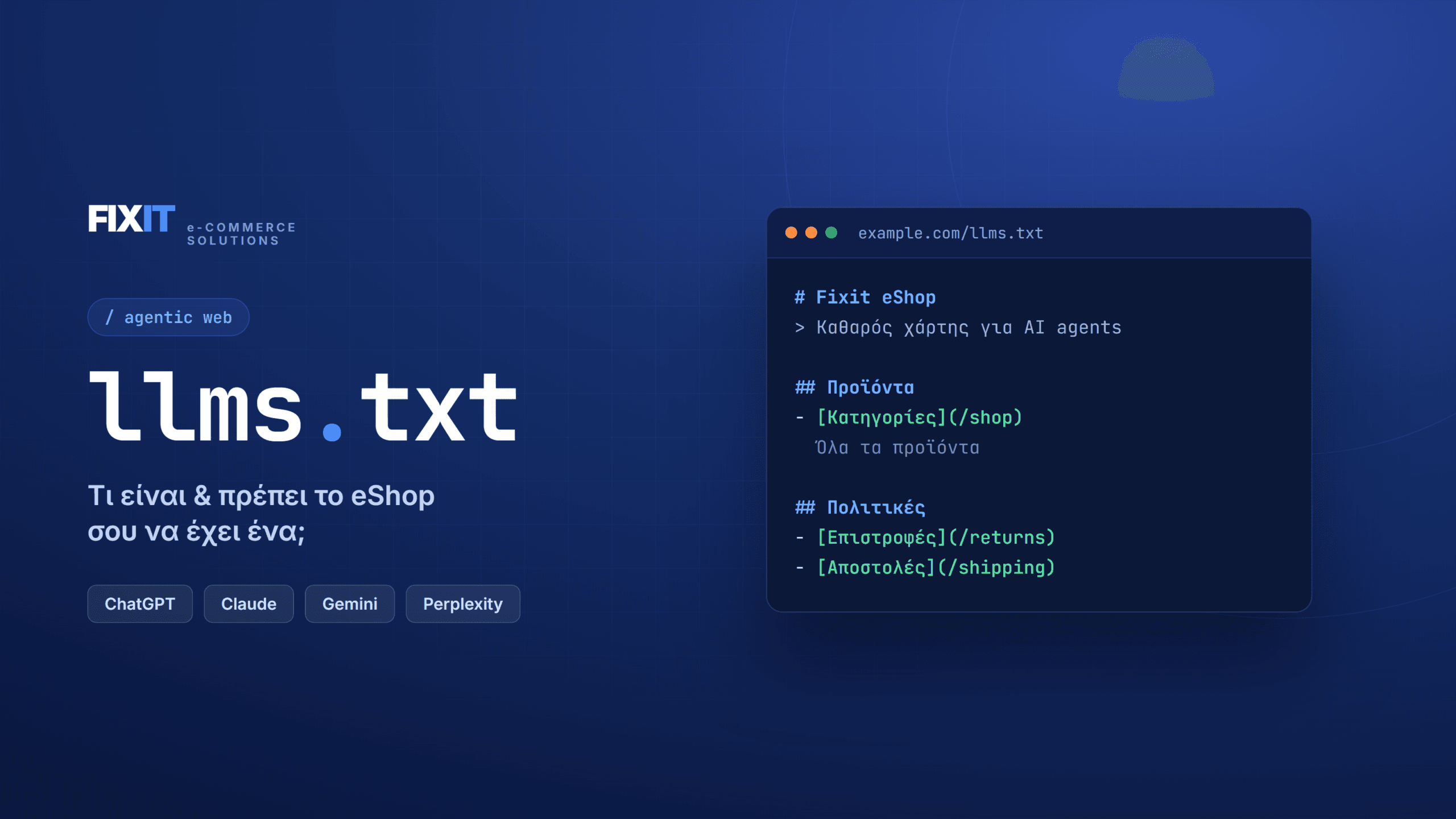
The llms.txt is a simple text file placed at the root of a website (e.g. `yoursite.com/llms.txt`). Its purpose is to provide large language models (LLMs) with a concise, structured, and easy-to-read overview of the content of the website. Unlike traditional files like `robots.txt`, which give instructions to search engines, `llms.txt` provides actual content and metadata specifically designed for AI to understand.
The transition from SEO to AI Optimization
Traditionally, SEO focused on ranking in search engines based on keywords. Today, users are increasingly using AI tools that “read” entire web pages to synthesize answers. `llms.txt` acts as a roadmap for these AIs, allowing them to quickly understand the business entity, main products and services without having to wade through thousands of HTML pages. This ensures that the information delivered to the end user is accurate and focused.
File structure and content
The file typically contains sections that define the website title, a short description, a list of major product categories, and possibly guidelines for how the company should be referenced. It may also include links to pages that are considered most important for understanding the value of the business. This structure helps the model avoid “hallucination” and base its answers on documented data.
How does adopting llms.txt benefit an e-shop?;
For an e-commerce store owner, adopting `llms.txt` opens up new avenues for attracting customers through new search channels. AI agents, such as those that power Google models or third-party platforms, depend on the quality of the data they receive. A well-structured file ensures that your business appears as a trusted source.
Improving the accuracy of AI responses
When an AI model asks “What are the best home products in Greece?”, and your website has an `llms.txt` that clearly defines product categories and features, the likelihood of your company being accurately mentioned increases dramatically. This translates into higher quality traffic, as users arriving via AI search already have a clear understanding of what you offer.
Speeding up the reading process by bots
Processing the entire database of an e-shop (especially in Magento with thousands of SKUs) is computationally expensive for an AI. `llms.txt` provides a “summary” that allows the model to make decisions quickly. This is critical for the performance of AI agents operating in real time, ensuring that the response to the customer is prompt and informed.
Implementation strategy and best practices
Creating an `llms.txt` is not just a technical exercise, but part of a broader AI Optimization (AIO) strategy. Fixit EE proposes an approach that focuses on data quality and clarity of presentation, to align with the needs of modern AI models.
Data organization and categorization
Before creating the file, it is necessary to redesign the data presentation logic. What are the main categories? What are the unique selling propositions (USP) of the company? The list in `llms.txt` should represent this structure, offering a clear hierarchy that helps the AI understand the relationship between products and services.
Continuous monitoring and updating
`llms.txt` is not a “set and forget” file. As your e-shop evolves, new products are added, or marketing strategies change, the file needs to be updated. Fixit EE can develop automated processes (custom MCP servers) that connect `llms.txt` to your content management system, ensuring that the data read by AI is always up-to-date.
Advice: Don’t overload the file with technical detail. The goal is to give the AI a clear “prompt” about who you are and what you do, not to expose your entire database.
Comparison with traditional methods
To better understand the difference, let's look at how the traditional approach works in relation to the innovation of `llms.txt`.
| Feature | Traditional SEO (HTML crawling) | AI Optimization (llms.txt) |
|---|---|---|
| Target | Search engine ranking (SERP) | Accurate information retrieval by AI agents |
| Structure | Advanced HTML, JavaScript, CSS | Plain Text |
| Accessibility | Requires crawling the entire site | Direct reading from a central source |
| Impact | Visual presentation of results | Data-based response composition |
Adopting `llms.txt` does not replace traditional SEO, but complements it, creating a strong foundation for the future of search. As e-commerce platforms evolve, the ability to “speak” the language of AI becomes a prerequisite for success.
Fixit EE specializes in developing advanced AI solutions, including custom MCP servers and automation for Magento and WooCommerce e-shops. If you want to optimize your business presence for the AI era, contact us for a personalized approach and analyze how `llms.txt` and other AI technologies can increase your performance.