Introduction
Proper product data management is the cornerstone of a successful Skroutz online store. As the platform evolves, e-shop owners are asked to choose between traditional XML feeds and the new, more dynamic API approach. This decision is not just technical, but directly affects the up-to-dateness of inventory, the accuracy of prices and ultimately, the turnover of your business. At Fixit EE, with our experience in developing Magento and WooCommerce solutions, we objectively examine the advantages and challenges of each method.
The Key Difference: Static Files vs. Live Link
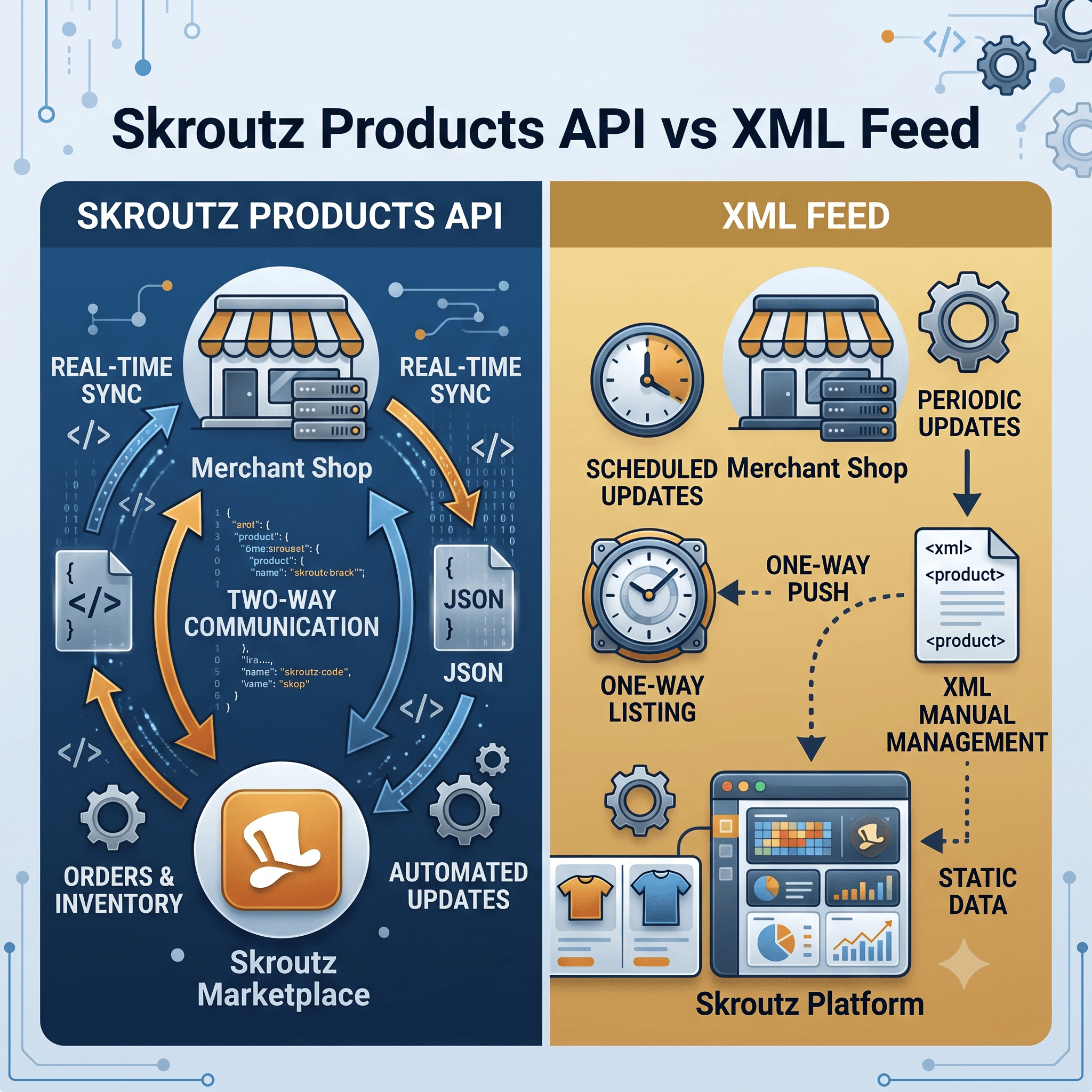
The choice between XML feed and API determines the rate at which data travels from your ERP or e-shop to the marketplace. Understanding the architecture of each method is essential before implementation.
How XML Feeds work and their limitations
XML feeds are the classic method of linking. They work on the basis of a static file that is periodically generated by the e-shop system. This file contains a “snapshot” of the products, prices and stocks. When Skroutz processes this file, it updates its database. The main disadvantage is latency. If a product is sold out immediately after the file is generated, Skroutz will continue to display it as available until the next update, which can lead to disappointing orders.
The benefits of API Connection
The API (Application Programming Interface) approach is the modern alternative. Instead of generating and sending a file, the e-shop connects directly to Skroutz systems via data calls. Whenever an update is required, the system sends exactly the data that has changed or checks the repository in real time. This eliminates latency and ensures that the availability in Skroutz is always compatible with the reality in your store.
Cost, Maintenance and Performance Analysis
Beyond the technical implementation, the choice affects the budget and time required to manage the store. Needs vary depending on the volume of orders and the size of the warehouse.
Infrastructure Requirements and Platform Compatibility
Implementing an XML feed is usually simpler and requires fewer server resources, as the process is asynchronous. However, for large stores, the frequent generation of large files can burden the server. In contrast, API connection requires more complex software to handle the continuous calls. For e-commerce platforms such as Magento or WooCommerce, Fixit EE offers specialized tools that simplify this process. For example, Skroutz Feed XML for WooCommerce is a proven solution that ensures correct data formatting for WooCommerce, minimizing human error.
Management Strategy for Magento and WooCommerce
Depending on the content management system you use, the approach may differ. In Magento 2, the complexity of the architecture often requires a more specialized approach. The Skroutz XML for Magento 2 is a tool that adapts to the specifics of the platform, ensuring that product characteristics correspond correctly to Skroutz categories. For stores wishing to expand to other distribution platforms, such as Wolt, the use of special feeds such as Magento 2 Wolt Feed shows how the modular approach allows for expansion without the need for a complete system rebuild.
Fixit EE Tip: Don’t consider XML feed as a “permanent solution” if your order volume is high. Moving to APIs or using specialized XML plugins that support more frequent scheduling is critical to avoiding out-of-stock products.
Practical Application and Data Management
Successful connectivity is not just about transferring data, but also ensuring its quality. Field accuracy, translation, and proper categorization are crucial for appearing in search results.
Data Integrity and Images
The quality of the feed determines the end consumer experience. An error in the image URL or description can lead to the listing being rejected by Skroutz. Especially for e-shops that manage many products, using tools like WooCommerce Meta Feed XML allows metadata to be customized to perfectly match market requirements. This ensures that prices and promotions are displayed correctly, increasing the likelihood of clicks.
Connection to External Systems (ERP, Courier, myDATA)
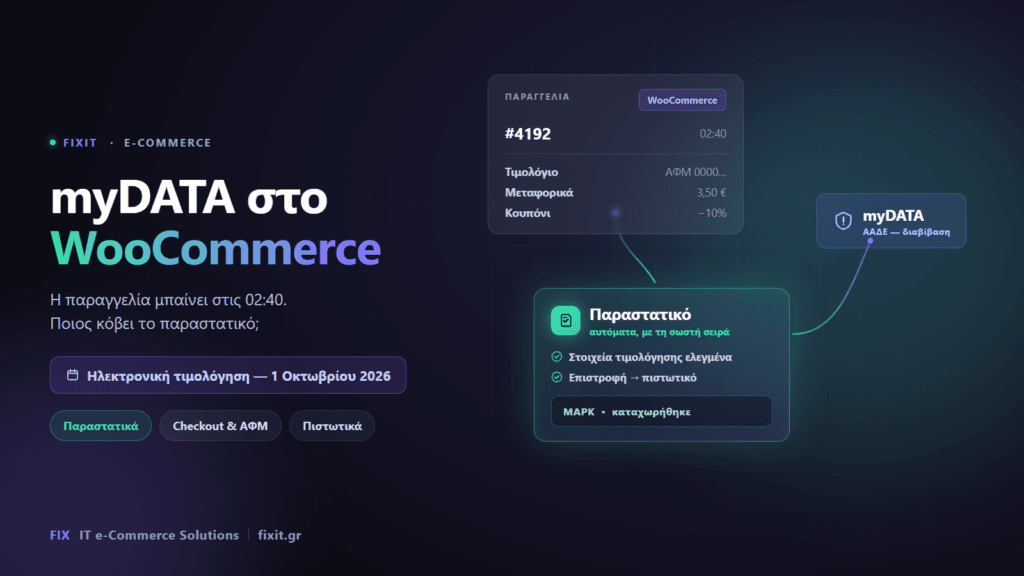
In an integrated ecosystem, the feed does not operate in isolation. The data flow must be connected to the order management and warehouse systems. Fixit EE has designed solutions that allow connection to Skroutz, IRIS, myDATA and courier systems, creating a feedback loop. For more information on how this integration is achieved, you can visit our page for connection with Skroutz, IRIS, myDATA and courier. Proper data flow ensures that the order in Skroutz automatically updates the inventory and issues the document process.
Solution Comparison: Summary Table
To make your decision easier, we present a comparison table of the main features:
| Feature | XML Feed (Traditional) | API (Modern) |
|---|---|---|
| Update Frequency | Periodic (hourly/daily) | Almost in real time |
| Adequacy of Computing Resources | Low (file generation) | Moderate (continuous calls) |
| Implementation Cost | Usually lower | Higher initial cost |
| Repository Accuracy | Subject to delays | High accuracy |
| Ease of Management | Simple file setup | Requires technical support |
The choice between Skroutz Products API and XML Feed depends on your sales volume, inventory turnover frequency, and available resources. While XML remains a reliable solution for smaller stores, API offers the accuracy needed to compete in large inventories. Fixit EE is ready to analyze your needs and implement the solution that best fits your network, whether through custom XML feeds or complex API integrations. Contact us for a quote tailored to your priorities.