Magento vs OpenCart: Which eCommerce Solution is Better?;
Choosing between Magento and OpenCart is not easy.
Both are open source PHP-based platforms that offer easy-to-use dashboards, flexible catalogs, and extensible code bases. Additionally, both solutions have large ecosystems of users, developers, and solution providers.
What is Magento?
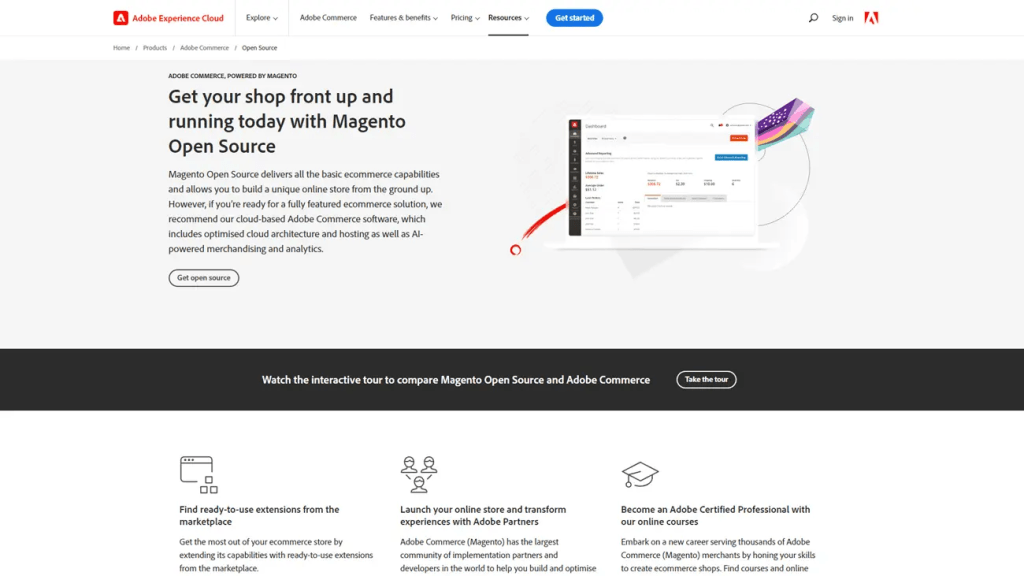
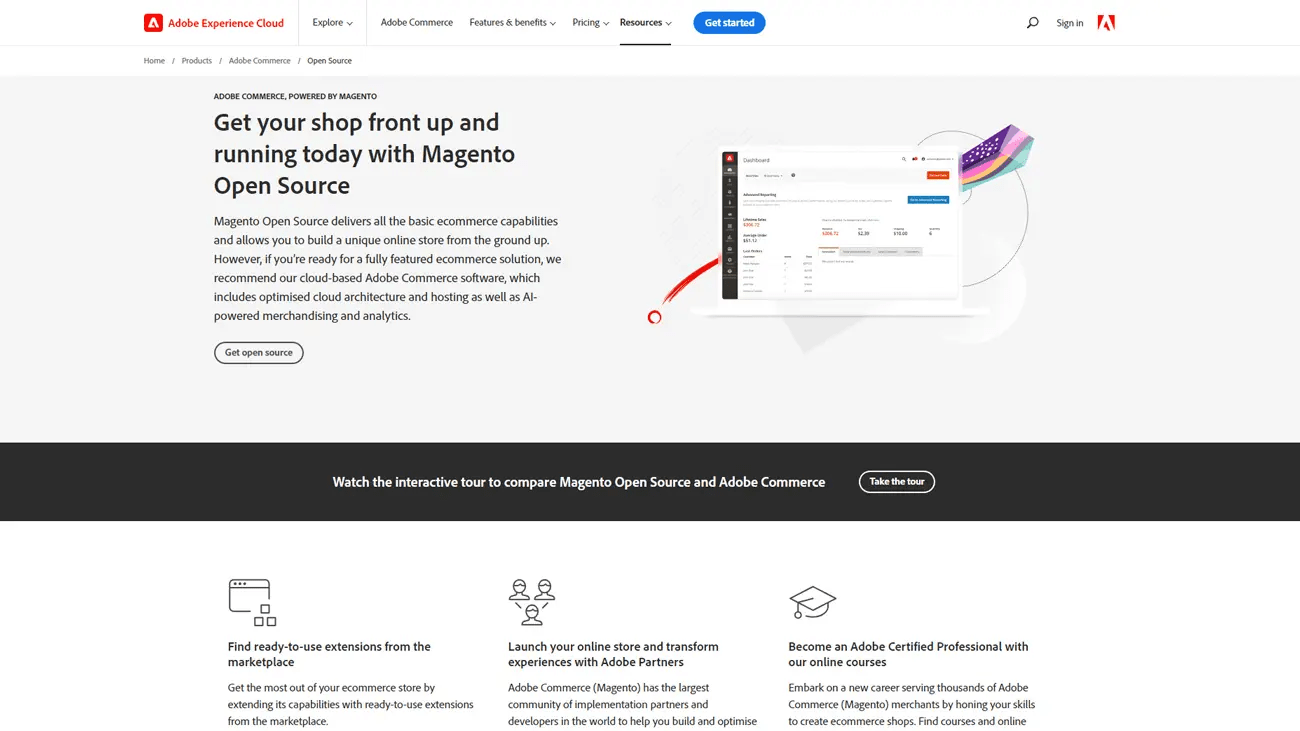
The Magento is an e-commerce platform open source that provides a wide range of capabilities, such as catalog management, order management, customer management, and checkout. It has a modular architecture that makes it easy to customize the platform's functionality.
Magento is available in two versions:
- Magento Open Source : A free version with basic e-commerce functionality.
- Adobe Commerce : A paid, enterprise version with advanced features, such as AI-powered product recommendations and customer segmentation.
Magento Open Source has everything you need to start an online store. It supports unlimited products and can serve thousands of simultaneous customers.
On the contrary, the Adobe Commerce provides more advanced features, enterprise-grade hosting, and technical support from Adobe.
Both Magento versions support multiple API technologies such as REST, GraphQL, and SOAP. This makes it easy to integrate a Magento store with third-party CRM and ERP systems.
Advantages of Magento
There are many advantages to using Magento, including:
- Code-free content management : Magento's page builder allows you to manage content and customize page layouts without code, just like Shopify and the BigCommerce.
- Powerful product management : Magento supports multiple product types and enables the ability to customize the product selection interface for customers with 10+ unique input options, such as drop-downs and visual samples.
- Advanced inventory management : Magento allows for the assignment, tracking, and management of multiple inventory sources for products.
- Optimized checkout : Magento minimizes cart abandonment with a one-step checkout module that allows customers to place orders without navigating through multiple tabs or pages.
- SEO-friendly features : Magento simplifies ecommerce SEO with features like structured data, custom URL structures, metadata, URL rewrites, and built-in support for sitemaps and robots.txt files.
- Integrated security : Magento uses multiple security measures, such as two-factor authentication and custom admin URLs. It also allows for secure online payments with built-in payment gateways.
Disadvantages of Magento
Magento has a few disadvantages, such as:
- Steep learning curve : Installing and updating Magento is done only from the command line.
- Expensive : The cost of hosting a Magento store can reach several thousand per month, depending on the size of the store. In addition, hiring a Magento developer for custom development it can cost quite a bit of money but it is necessary.
- No support : The open source version of Magento does not receive any technical support from Adobe. When things go wrong, the only options are to contact the community via Stack Exchange and the official Magento forum, or to contact the developer who has taken over the store.
What is OpenCart?;
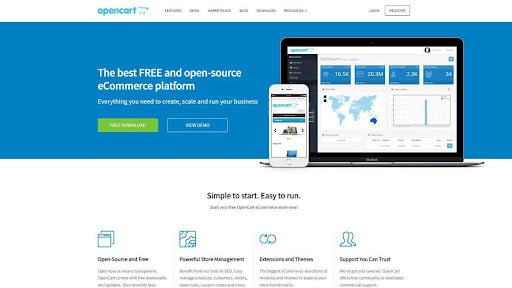
OpenCart is an open source platform that provides basic e-commerce functionality such as catalog, products, and order management. It is free to use and has a lightweight, extensible code base.
OpenCart is a great solution for businesses that need an online store with low operating costs. It offers useful features like affiliate management, reward points, and multi-currency support that are ideal for direct-to-consumer brands.
Additionally, OpenCart is just as customizable as Magento. It has an API for integrations and even provides the option of paid managed cloud hosting.
Advantages of OpenCart
OpenCart offers many benefits, including:
- Easy management of operating units : OpenCart allows management of its core modules from the admin panel. Unwanted modules can be disabled to reduce bloat and free up server resources.
- Code-free store management : Like the WooCommerce, OpenCart allows extensions to be installed and managed from the admin panel.
- Multiple support options : OpenCart provides various support options. Free access to online resources and community forums or dedicated support can be obtained for a fee.
- Large online market : The official OpenCart marketplace contains over 13,000 extensions and themes. Additionally, OpenCart themes and extensions can be purchased from third-party marketplaces.
- Built-in affiliate marketing tools : OpenCart enables the creation of affiliate marketing programs with custom tracking codes, commissions, and payment methods without third-party extensions.
- Easy backups : OpenCart allows on-demand backups of the store database.
Disadvantages of OpenCart
OpenCart has some disadvantages, such as:
- Poor documentation : OpenCart's online documentation lacks detail. It doesn't explain hardware requirements, basic store setup tasks, or OpenCart security in a beginner-friendly way.
- Limited product management capabilities : OpenCart does not support grouped products. It also lacks support for multiple inventory sources and low stock notifications.
- Complex product creation workflow : OpenCart's product creation workflow configuration does not allow for quick creation of product variants.
Cost estimates for Magento vs. OpenCart.
Magento is more expensive than OpenCart because it is more resource intensive. However, despite the higher hosting costs, Magento provides more features than OpenCart.
Magento allows for the use of powerful search technologies. It also offers a code-free content editor, more product types, and advanced shipping configurations.
Adding these features to OpenCart would require multiple extensions and more hosting resources to keep it fast and responsive.
Security issues for Magento vs. OpenCart
Magento and OpenCart are software that put the responsibility for online store security on the store owner themselves. Both provide security features such as custom admin URLs, HTTPS support, and user access management. But only Magento offers advanced features such as:
- Two-factor authentication : Magento enables two-factor authentication by default for all admin users.
- CAPTCHA : Magento offers CAPTCHA validation to protect storefront forms and the admin login page from brute force attacks.
- Data encryption : Magento uses AES-256 encryption for sensitive data like customer and payment information and secure hashing algorithms for non-sensitive data.
- Strict content security policies : Magento uses strict content policies to prevent card skimming and clickjacking attacks.
- Protection against cross-site request forgery and cross-site forgery : The core Magento framework uses input validation, output encoding, and secure form keys to protect against code injection attacks.
- Free security scanning tool : Adobe offers a free online tool that allows over 21,000 malware tests to be run on the store and provides suggestions for improving security in Magento.
OpenCart's security documentation only shares basic security tips, such as updating file system permissions and .htaccess files. In comparison, Magento's security documentation offers detailed guides that help protect your store in many ways.
Digital marketing and SEO tools for Magento vs OpenCart.
Magento offers SEO features such as structured data markup product templates, metadata optimization, URL rewriting, automatic redirects, and sitemaps. It stands out as a merchant-friendly e-commerce platform with Google Adwords and Analytics integration.
Magento allows for A/B testing using Google Optimize, formerly known as Content Experiments. Different page designs can be tested to find what works best and optimize marketing strategies in real time.
Magento's Marketing menu includes flexible pricing rules, newsletter management, and search performance reports.
It also offers a dedicated reporting tool for insights into marketing data, such as search terms, abandoned carts, conversions, and newsletter sends.
In contrast, OpenCart's SEO and marketing capabilities seem limited.
All the essentials, such as custom metadata, URL rewrites, sitemaps, and robots.txt files, can be obtained. However, important features like A/B testing, Google Analytics integrations, and custom pricing rules are lost.
OpenCart includes a coupon module that allows you to offer discounts on specific products and categories.
The only notable marketing feature in OpenCart is the affiliate module that supports custom discounts and tracking codes. Apart from that, Magento is a better platform for e-commerce marketing and SEO.
Magento vs OpenCart themes.
Magento and OpenCart offer free responsive themes and tools for designing progressive web apps (PWAs) for a native-like shopping experience.
This ensures that there is no need for a dedicated mobile app for the store.
Both platforms have official marketplaces where third-party themes can be purchased for the store's appearance.
However, the official Magento theme store only has six free and paid themes, while OpenCart has over 1,000.
Adobe's rigorous quality control program ensures that every theme in the marketplace goes through multiple quality checks before being listed. OpenCart doesn't have such programs, so it's easier for developers to offer themes in the OpenCart marketplace.
Epilogue.
It is clear that Magento is aimed at online stores with large inventories, while significantly improving the security field. The pricing statements of both Opencart and Magento are not far apart, making Magento a better choice overall in the long run. It is important to recognize that the security of the customer's cart, their personal information and inventory management are among the most basic features that a store must meet today. Thus, it becomes clear that when asked which platform between Magento and OpenCart is better, the answer is clearly Magento.