Composable Commerce is beginning to emerge as the dominant architectural approach to e-commerce in 2025–2026. Its rationale is based on replacing traditional monolithic platforms with a series of independent and specialized services connected to each other via APIs. This composability allows businesses to shape e-commerce environments that operate with greater flexibility, faster responsiveness, increased scalability and a high degree of customization. The combination of the composable approach with artificial intelligence creates a new kind of intelligent ecosystem, in which each subsystem can not only operate autonomously, but also make decisions, predict behaviors and optimize its operation without human intervention.
In 2025–2026, the convergence of Composable Commerce with AI systems is considered an inevitable development. Businesses now see the e-shop not as a single application, but as a set of modular functional modules that are redefined based on user needs and market trends. Artificial intelligence takes a central role in this ecosystem, transforming these modules from simple services into mechanisms that coordinate information, analyze data and function as dynamic organizations. The following analysis presents how the modern e-commerce architecture is evolving, the business background that leads to the adoption of Composable Commerce, the impact of AI at every level of operation and the changes expected by 2026.

The Concept of Composable Commerce
Composable Commerce is a model for developing e-commerce stores in which the entire operation is not managed by a monolithic platform, but by a set of independent and specialized systems that communicate with each other. This model has been adopted due to the need for greater flexibility in markets where the speed of change of requirements is high and where businesses wish to determine their own technological priorities.
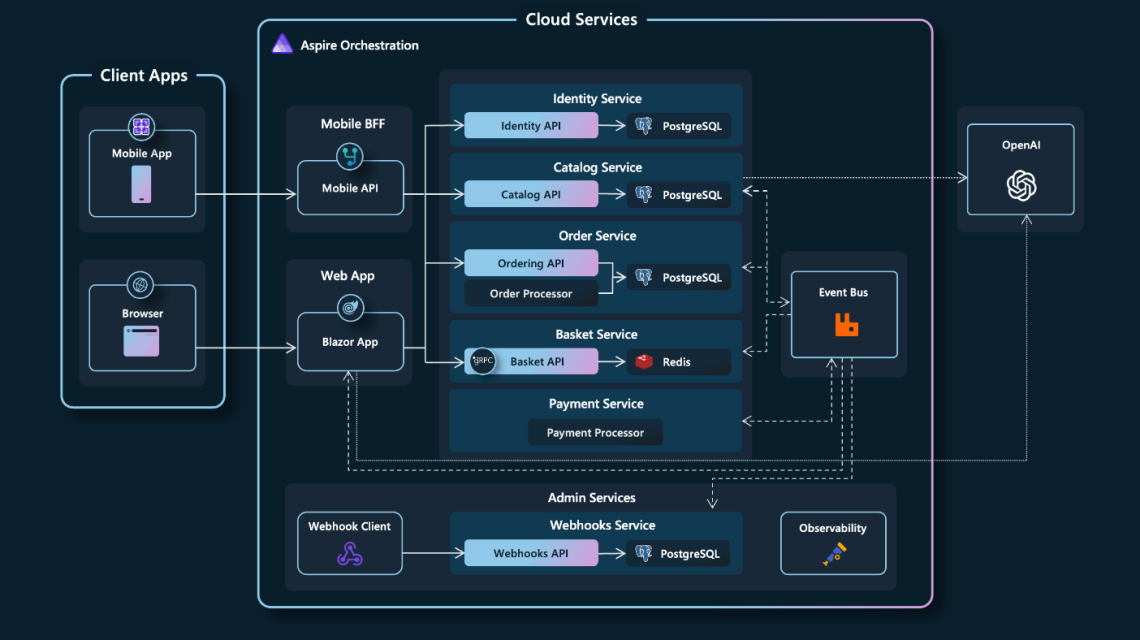
The logic of composition allows businesses to choose the services that best fit their structure and needs rather than being forced to adopt a platform that defines their experience. For example, the payment function can be implemented by a specialized system, search by another service that supports semantic analysis, while inventory management can be performed in a separate microservice. This separated structure allows each service to be replaced, upgraded, and improved independently of the others.
This architecture is based on API-first approaches, where service communication is not limited by the programming language or the system on which they run. Composable Commerce supports microservices, containerized infrastructures, and flexible patterns such as event-driven communication. This way, high responsiveness is achieved even in demanding environments where the user base is large or functions must be automatically scaled.
The shift from monolithic to composable architectures has arisen from the need for diversification and faster innovation. The monolithic model struggles when rapid changes are required, because each modification often requires changes to a large area of the code. In contrast, with the composable model, each module operates independently, which allows small teams to work in parallel on different parts of the system without interfering with the overall ecosystem.
The Role of AI in Composable Commerce
Artificial intelligence acts as a power multiplier for Composable Commerce, allowing each service to gain capabilities that previously required significant human time or specialized processes. AI transforms microservices from simple functions into intelligent units capable of making real-time decisions, anticipating needs, recognizing patterns, adapting the system, and operating autonomously.
The application of AI in composable architecture occurs at many levels. For example, an inventory management system can be enriched with predictive models that calculate when replenishment will be needed. A pricing system can calculate optimal prices based on demand, competition, and user behavior. Artificial intelligence allows these systems to operate not only as independent services but as intelligent mechanisms that influence and coordinate other services.
One of the biggest advantages of AI in a composable environment is that models can be trained on data from a specific subsystem without depending on the rest. Thus, each part of the e-shop can develop its own “intelligence” based on its own data. This allows for high accuracy in predictive models, personalization engines and decisioning systems.
Additionally, AI empowers the way composable components are connected. It optimizes APIs, modifies workflows, selects alternative paths for service execution, and controls how components operate based on load, user behavior, or market trends. This intelligent orchestration creates systems that can operate autonomously, repairing errors and adapting their operation to real-world conditions.
Connecting Composable Commerce with Headless Architecture
The headless architecture is a prerequisite for the full exploitation of Composable Commerce, as it separates the frontend from the backend and allows for independent development and optimization of each part. In the headless environment, the frontend retrieves data via APIs from the various microservices and displays the content on multiple devices, such as web, mobile apps, POS systems, IoT devices and smart assistants.
With the integration of AI, the headless model gains new dynamics. Artificial intelligence can influence content at the UI level without requiring a change in the backend. The frontend can adapt in real time to the needs of each user, displaying different categories, alternative commercial messages, different taxonomies or even personalized page structure.
In headless environments, AI can operate directly at the edge via CDNs that support server-side computation. This means personalization can be implemented with zero latency, as decisions don’t have to go through the central backend. The result is faster pages, a better user experience, and greater efficiency of personalization operations.
Composable Commerce in 2025–2026
The period 2025–2026 is considered to be crucial, as composable architectures move from the adoption stage to the maturity stage. Systems begin to operate as autonomous organizations, where each service has the ability to redefine its role based on performance, demand, and business priorities.
One of the most important features of the new era is the dynamic composition of services. The choice of subsystems is no longer statically determined. Instead, systems can recompose their operation mode depending on the load, user needs, or market conditions. For example, the search system can change its operation mode depending on user behavior or the level of server responsiveness.
Additionally, composable systems now have self-improving capabilities. AI allows services to evaluate their performance, track which workflows produce the best results, and change their settings without human intervention. This is the evolution from traditional automation systems to autonomous decision-making systems.
Microservices + AI
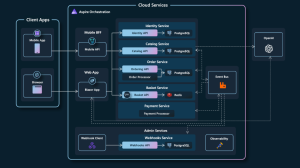
Integrating AI into microservices turns every service into an intelligent building block. This capability is achieved by embedding machine learning models directly into microservices or through cloud functions that manage model training and execution.
Microservices, through AI, are able to analyze their data locally and make decisions related to their service. For example, an inventory microservice can calculate potential stock shortages, send warnings to the ERP, notify procurement, and update API responses for products so that the e-shop displays accurate availability information.
Similarly, a pricing microservice can perform hundreds of calculations per hour, taking into account competitive prices, seasonality, profits, and demand levels, to dynamically adjust prices in the e-shop. This dynamic was not possible in older architectures, where price changes could only be implemented manually or at infrequent intervals.
The Role of AI Agents as a New Level of Logic
AI Agents act as a middle layer of logic that connects microservices, APIs, and business processes. Agents are not just bots that answer questions, but self-contained units that monitor systems, analyze actions, identify problems, and perform complex actions in e-commerce systems.
Agents act as “connectors” between composable services. They monitor their performance, evaluate which service produces the best results, detect delays or errors, and inform the system to choose an alternative operational flow. In this context, AI Agents take on a role similar to orchestrators that optimize the communication of individual blocks.
Personalization in a Composable Environment
Personalization in a composable environment is not limited to product recommendations but extends to every touchpoint with the user. The entire e-shop experience can be dynamically customized, from the way categories are displayed to the banners that appear, the content sections that are activated, and the checkout processes.
AI enables understanding of user intent. Based on behavioral data points, the user is classified into dynamic behavioral profiles without the need to create static segments. The next page that appears is customized based on interest, products viewed, or time spent on specific sections.
Personalization of this form is only possible in a composable environment, because it requires full flexibility of subsystems and the ability to dynamically compose content.
Search in Composable Systems
Search is a central function and in a composable environment it operates as an independent subsystem with AI capabilities. Search engines have evolved into semantic engines that can understand the natural meaning of terms and recognize user intent.
AI enhances search with contextual ranking, where results are determined not only by relevance but also by user behavior. Search can be customized to display different results based on a user’s previous activity, the category they came from, or even how they navigated.
Omnichannel Architectures with AI
Composable Commerce serves environments where businesses operate in multiple places at once. AI enhances this functionality by connecting data from all channels and enabling the creation of a unified user experience.
In the modern omnichannel architecture, the user can start a purchase process in the mobile app, continue on the site and complete the order in the physical store. The composition of services that support each channel is carried out through composable models and AI identifies where the user is in the journey, what steps need to be completed and how the next action can be supported.
AI-Driven Checkout
Checkout is one of the most critical processes in an e-shop, as it directly affects the conversion rate. In a composable environment, checkout operates as an independent subsystem with the ability to integrate AI models that optimize the user's path to purchase.
AI can recognize when a user is at high risk of abandonment and adjust checkout steps to reduce barriers. It can also choose which payment provider to display based on successful transaction history, fees, or geographic region, resulting in a checkout that dynamically adapts and operates as efficiently as possible.
Backend Automations
Behind the scenes of an e-shop, AI powers a range of functions that are not visible to the end user but significantly impact operational efficiency. Predictive models calculate future inventory levels, while other services analyze returns and identify which products are causing systematic problems.
AI can monitor supplier performance, detect delivery delays, or suggest alternative suppliers based on historical data. Integrating these functions in a composable environment allows each subsystem to operate with high autonomy and accuracy.
Conclusions
Composable Commerce with AI represents the most advanced form of e-commerce architecture for the period 2025–2026. The adoption of independent specialized services, microservices, headless subsystems and AI-driven functions creates online stores that no longer operate as static systems but as dynamic, self-improving organizations. Artificial intelligence enhances every level of the composable structure, enabling faster and more intelligent decision-making, higher adaptability and significantly improved user experience. As e-commerce evolves, the composable model with AI is expected to become the dominant technological ecosystem that will define the way e-shops operate in the coming years.
For businesses planning a transition to composable commerce and need technical guidance on integrating microservices, headless architectures, and artificial intelligence automation, there is the opportunity to collaborate with experienced development teams that have comprehensive expertise in modern e-commerce architectures. Fixit.gr has the ability to provide technical design, requirements analysis, development of custom integrations and actual conversion of e-shops into composable systems that operate with the highest levels of speed, stability and intelligence.