When it comes to top-tier content management systems (CMS), WordPress' dominance is considered undisputed. However, when the focus shifts to the runners-up, the real debate now centers on Drupal vs. Joomla. Which one ranks second in the CMS industry (after WordPress)?;
Drupal vs. Joomla: At a Glance

It's easy to see why Joomla and Drupal are constantly compared. Along with WordPress.org, they are considered the heavyweight champions of CMS. These three systems share many common features:
All have been created since the early 2000s, yet their value remains undiminished to this day.
They are open source, allowing anyone to use them and create websites at no cost.
PHP is used as the main programming language, while MySQL is their database.
What's most impressive is that, even after more than 20 years, both Joomla and Drupal continue to receive new and exciting updates, maintaining their position in the market.
For example, Drupal has added APIs, which allow users to create complex website structures using predefined functions. At the same time, Joomla has integrated a brand new Dark Mode, which automatically synchronizes with the user's device, improving the design experience at night in terms of both comfort and aesthetics, making it easier on the eyes and much more elegant.
Drupal vs. Joomla: Which is better?;
Joomla is distinguished by its balance between ease of use and flexibility, making it an ideal choice for small and medium-sized businesses, bloggers, and developers who want to create dynamic websites without the need for specialized technical support.
It features a user-friendly administration interface, a powerful content management system, and numerous extensions that allow website customization without complex programming. In addition, Joomla integrates advanced SEO features by default, helping websites achieve better search engine rankings.
In contrast, Drupal, while extremely powerful and offering unsurpassed adaptability, requires deeper programming knowledge. While it can support extremely complex and high-scale projects, such as government and educational websites, it is more demanding to learn, making it less accessible to individual users and small businesses.
Ultimately, the choice between Joomla and Drupal depends on the needs and resources of each project. For those looking for a powerful, yet easy-to-use and flexible website builder, Joomla is a great solution. Conversely, for those with greater demands on security, customization, and scalability, Drupal may be the better choice—provided the necessary technical expertise is available.
Ease of Use (Joomla wins)
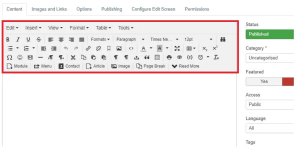
One of the most important criteria when choosing a CMS is how easy it is to use. If the interface is complicated, then the CMS will end up being more of a problem than a solution.
Drupal: Steep learning curve
Drupal is known for its great flexibility, but with that flexibility comes complexity. Installing Drupal may be simple, but once you start configuring your website, things get a lot more complicated.
- Content management: Adding and editing content requires some familiarity with the system. It is not as intuitive as other CMS platforms.
- Adjustment: Advanced customizations require knowledge of PHP, HTML, and CSS, which makes it difficult for beginners to use.
- Learning: Even for experienced users, Drupal can be difficult to understand due to the complexity of its modules and settings.
Joomla: User-friendly and flexible
Joomla, on the other hand, offers a much friendlier way of managing content.
- Installation: It's relatively easy, with a guided installation wizard.
- Content management: Joomla has a more intuitive administration interface, which allows beginners and non-programmers to easily manage articles, menus, and sections.
- Scalability without programming: Although it requires some familiarity, Joomla customization is much more accessible to non-programmers than Drupal.
The verdict
Joomla offers a more user-friendly control panel, making it ideal for both beginners and advanced users. In contrast, Drupal requires technical knowledge and has a steep learning curve, making it less accessible to those without programming experience.
Website Management (Joomla Prevails)
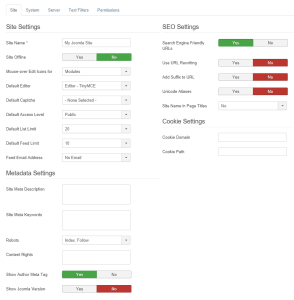
Since both platforms, Drupal and Joomla, are CMS, there is probably interest in how websites are allowed to be managed through them. According to practical experience, slightly different approaches are followed.
Drupal Website Management
When it comes to website development, a fairly dynamic approach is offered through Configuration synchronization (although, as mentioned, technical expertise is required):
The path "Administration" > "Configuration" > "Development" > "Synchronization" can be followed to import or export files. After synchronization, all changes are applied immediately, whether it is activating new modules, adding custom fields, or creating new content types.
If the use of command line tools is preferred, commands such as drupal config: edit or the drush config-edit to directly modify the website configurations.
Full control over the website configuration settings is retained by administrators.
Additionally, content management is facilitated through an intuitive interface. Articles can be published with images or embed external links (e.g. YouTube videos) without much difficulty. At the same time, powerful filtering options allow for easy management of articles and guest comments:
- Articles can be sorted by status, title, type, and language to keep track of which ones are active, which ones are pending, and which ones need editing.
- Comments can be selected from a list and, with a few clicks, unpublished or deleted.
Joomla Website Management
Like Drupal, flexibility is provided in website and content management through Joomla.
However, there is one important difference: No technical skills are required. Access to the “System” > “Global Configuration” section allows for easy modification of settings through a comprehensive management system, without the need for specialized knowledge.
More information can be found through the official Joomla documentation.
Additionally, for those looking for more personalized settings, 30 free custom code units are provided, through which HTML, CSS, JavaScript, and other programming code can be added to the website.
The Verdict
Joomla's functionality allows for easier access and management by users of all levels – from beginners to experienced developers. In contrast, Drupal is primarily aimed at the latter.
Therefore, Joomla emerges as the winner in this comparison!
Performance (Joomla wins)
Even with the smartest design and best settings, visitors are likely to abandon a website if it loads too slowly. After all, speed is considered a determining factor in today's digital world. Therefore, performance should be taken seriously when choosing between Drupal and Joomla for a business.
Drupal Performance
Overall, Drupal offers the freedom to choose a hosting provider, as it is considered an open source platform. Furthermore, it is supported by almost any web server that meets PHP requirements, giving users a lot of options.
However, there is one drawback: due to the large number of import files, Drupal loading delays are common, even when using the best hosting providers. During tests conducted with Hostinger, it was found that the first load took about 5 to 7 seconds – a test of visitors’ patience.
Even though subsequent visits (the second and third loads) were much faster, taking less than 3 seconds, first impressions still matter. After all, if the initial load is slow, visitors may abandon the site before they have a chance to see its content.
Joomla Performance
Like Drupal, Joomla offers complete freedom in choosing a hosting provider. There are many options available, as long as you ensure that the chosen provider has the necessary features and meets the following requirements:
- Stable LAMP stack (Apache Server, Linux, MySQL, PHP/Perl)
- PHP 5.3.10 or later
- Access to MySQL (version 5.1+)
- FTP or control panel access
- Support for mod_rewrite (vital for SEO-friendly URLs) as well as other useful modules like mod_sql, mod_zlib, curl, mod_xml, and the GD library.
Speed is maintained at a high level, as Joomla allows loading in about 2-3 seconds, which makes it faster than other open source platforms. Even better, when caching and G-zip are enabled (in the “Server” tab within the “Global Configuration” settings), the loading time is reduced to just 1.5 seconds!
Conclusion
Although Drupal's speed improves after a few loads, Joomla's superior performance makes the navigation experience faster from the first click, rightfully earning the top spot in this comparison.
Multi-language support (Tie)
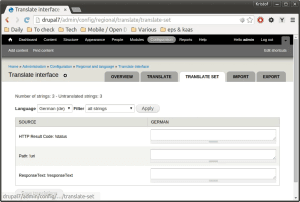
Who wouldn't want their website to connect with audiences from every corner of the world? For this reason, multilingual support is considered a crucial factor for any successful CMS. During intensive testing conducted over weeks, the comparison between Drupal and Joomla was based on this criterion and the following findings emerged:
Language support in Drupal
The multilingual support in Drupal has been particularly impressive. More than 100 languages are available, offering a significant advantage compared to most platforms on the market! Furthermore, languages that are read from right to left (such as Farsi, Arabic or Hebrew) are fully supported by default.
In addition to the large number of languages, four basic multilingual modules are provided that allow the translation of almost every element of a website:
- The unit Language used to easily switch between languages.
- The unit Interface Translation allows the translation of buttons, labels, menus, and other user interface elements.
- The unit Content Translation makes it easy to translate blog posts, product descriptions, custom fields, and other content.
- The unit Configuration Translation allows translation of embedded settings and content blocks.
A major advantage of Drupal is its intelligent language detection and selection system. The user's preferred language can be automatically identified (even before a button is clicked), based on IP address, browser settings, URL, session, and other criteria.
Language support in Joomla
Unlike Drupal, Joomla does not offer built-in multilingual support. However, solutions have been developed and provided through extensions – the top choice being GTranslate (which is completely free). With its installation, a website can be translated into 103 languages, while also enabling SEO optimization for multilingual content.
In addition to GTranslate, 28 additional extensions have been created, which can:
- They speed up the translation process
- Automatically scan each line of text so nothing is left untranslated
- Create local versions of the website for better global reach
- Allow translations to be customized with special glossaries and rules, ensuring absolute accuracy.
Conclusion
It could be argued that the lack of built-in settings gives Joomla a disadvantage over Drupal. However, the available extensions more than make up for this, offering easy and user-friendly solutions.
Automated Workflow (Joomla Wins)
With artificial intelligence and automation transforming industries across sectors, it's natural to wonder how Drupal and Joomla are faring in the face of the growing demand for automated workflows. Here are the results:
Automated workflow in Drupal
Recent research has shown that Drupal has a Flow (Automation) module, which works exactly as its name suggests. Tasks can be configured to be triggered automatically whenever content is created, saved, or deleted, without the need for any action from the user!
The Flow module in Drupal associates each task with a specific data type (e.g., "article" node type), so that it knows exactly what to do and when. Once activated, the module offers some additional benefits:
- Merging and pre-populating field values (with Token support for dynamic content)
- Automated content creation, such as taxonomy terms, comments, and nodes
- Linking content and managing reports back, keeping everything organized
- Send emails or display custom messages
- Notify users and team members or trigger on-screen messages when certain conditions are met
- Create custom workflows with quality criteria (e.g., trigger a task only when an article is published)
Even better, the user has full control over how and when these tasks are executed. Flow takes care of queueing them and processing them in the background, so the website runs smoothly even when handling large data sets.
Automated workflow in Joomla
While Drupal is mainly based on modules, Joomla already has a built-in Task Scheduler, which is specifically designed for scheduled execution of recurring tasks. In just a few clicks, the time intervals at which automated tasks (cron jobs) should be executed can be configured through the «Basic Fields» section.
If the task requires more customization, the «Task Parameters» section allows for detailed parameter tuning so that everything works exactly as required.
Even better, the «Advanced» tab allows you to prioritize cron jobs so that the most important tasks are executed first and quickly.
The "Basic Fields" section allows for customization of cron jobs.
Additionally, if the user is familiar with APIs, Joomla's APIs can be used to automate the creation, updating, and even deletion of content. If desired, these APIs can even be integrated with external systems to automate the process of user onboarding and perform smooth data synchronizations.
Conclusion
Both Drupal and Joomla focus heavily on workflow automation, however Joomla wins due to the already built-in tools and ease of use of automation features.
eCommerce Capabilities (Joomla Wins)
Everyone knows that Drupal and Joomla are not typical eCommerce platforms. However, as open source CMSs known for their scalability, they continue to attract aspiring eCommerce entrepreneurs! For this reason, they should be compared to show how well they can help achieve business goals.
eCommerce capabilities in Drupal
Drupal offers around 4,900 modules for eCommerce, covering everything from inventory management to payment gateways and tax setup.
This number is much larger than the full catalog of applications of many specialized eCommerce platforms. So, although Drupal does not have built-in eCommerce features, one could say that the huge library of modules fully compensates for this.
However, there are some major disadvantages:
- All of these modules are placed in a huge category labeled «eCommerce.» There’s no easy way to filter them into smaller groups. For example, if you type «billing» for a billing module, you’ll have to scroll through the results until you find the right one.
- Also, anyone (with a Drupal account) can create and upload a module. The worst part is that Drupal does not take responsibility for any problems or security risks that arise from downloaded modules.
eCommerce capabilities in Joomla
Like Drupal, Joomla’s eCommerce capabilities rely heavily on extensions (263 in total). Of these, 85 – almost a third of the collection – are dedicated solely to payment gateways and systems. In addition, about 65 extensions focus on integrating Joomla with other eCommerce platforms (e.g. Ecwid) rather than turning Joomla into a full-fledged, independent store.
The total number of eCommerce applications in Joomla is 263.
So yes, it's a much smaller and more limited collection compared to Drupal and other platforms. However, there are a few points worth mentioning:
- No need for a lot of searching (like in Drupal), Joomla organizes these eCommerce extensions into smaller categories.
- Most importantly, these extensions are generally secure and well integrated with Joomla! Of course, it's always smart to check the update history and security patches.
Conclusion
Joomla outperforms Drupal with its stronger security and better organized extensions – both platforms still have plenty of room for improvement.
Applications and modules (Drupal wins)
The eCommerce analysis above has already mentioned the comparison of Drupal and Joomla in terms of extensions. To provide more information, this section will take an in-depth look at their app/module stores:
Drupal applications and modules
Currently, Drupal has an impressive collection of over 52,000 modules covering every area of web development! There are also useful filters that allow you to narrow your search by:
- Maintenance status (Active/low maintenance or unsupported)
- Development status (Active or not developing)
- Drupal version
- Date (release date, creation date, or relevance)
However, as mentioned, many of these modules are not covered by the Drupal security team.
Joomla applications and modules
Currently, Joomla has around 5,300 extensions. While it’s not as huge as Drupal’s library of 52,000, it’s still a pretty big collection! However, navigating through all of these options can be a bit difficult, as there are no filters for date, development, or maintenance status.
On the other hand, Joomla offers the «Show» option, which makes the navigation process easier. Also, as mentioned, Joomla extensions are generally more secure than Drupal modules, so there is less worry when installing/uninstalling them during testing.
Conclusion
Drupal easily outdoes Joomla with its massive library of 52,000 modules. However, security is an issue that should concern users.
Safety (Draw)
Now that security has been mentioned, it's time to take a broader look at the platform as a whole — not just the extensions and apps:
Drupal Security
Overall, aside from modules (the security of which is not Drupal's responsibility), Drupal has a strong reputation for ensuring the security of a website. The security team constantly monitors the platform and stays in close contact with users to identify and fix any issues as they arise.
Joomla Security
Just like Drupal, Joomla takes security very seriously, with a dedicated team that actively responds to problem reports from users. They even provide a transparent and well-organized process for dealing with these reports:
- Each report is confirmed within 24 hours.
- Within 7 days, it is followed up with either a solution or an update stating that further investigation is required.
- Within 21 days, the problem will be solved by 100%, unless there is a significant reason for the delay.
What's even more impressive is the regularity of their security updates.
Conclusion
Both platforms take the security of their users seriously and actively respond to their needs and concerns. Therefore, in this Joomla vs Drupal security comparison, it is impossible to have a clear winner.
Customer Support (Tie)
Finally, customer support plays an extremely important role for open source platforms. It is the lifeline that keeps newcomers and non-technical users from drowning in a sea of options!
Drupal Customer Support
The experience with Drupal support is generally pleasant. In addition to the extensive and detailed documentation and knowledge base, a capable team of Webmasters has been created who are always ready to help!
Through your Drupal account, you simply submit a support request to the issue queue, and the team will take care of it immediately.
If someone is unable to log in for some reason, they send an email to [email protected].
There is no phone support for either option, but the team responds fairly quickly.
Joomla Customer Support
Joomla customer support takes a unique approach compared to what you might find on other platforms. Instead of the typical support channels, it offers a «Report a Problem» section right in the dashboard. The process is pretty straightforward, but you’ll need to create a GitHub account first to access this section!
Within 24 to 48 hours, a support representative will take over the conversation and guide the person concerned step by step until the problem is resolved.
The discussion is then locked and marked as resolved.
Conclusion
While the technical steps differ slightly between the two platforms, the processes are the same: a request is submitted and a staff member will respond to it. Given their similar features and limitations (both don’t offer live chat/phone support), this matchup ends in a tie.
Final Thoughts
The truth is, Joomla won in almost every category. With a community that exceeds 3.9 million users and continues to grow, it's clear why more and more businesses are choosing to use it.
Each business, depending on its capabilities, should follow a personalized plan to remain competitive, maintain and increase its conversions so that it can grow in the digital landscape. The experienced developers of Fixit.gr they can help every business develop the right e-commerce store, guiding owners to make the right decisions.