ERP Integration in Magento. Complete Guide.
Integrating Magento into existing ERP (Enterprise Resource Planning) became easier when Adobe acquired the e-commerce platform in 2016. Magento announced the deal during that year's annual Shop.org conference, speculating that the partnership would improve e-commerce capabilities for merchants, allowing them to design and deliver personalized and memorable customer experiences across multiple channels.

The capabilities that emerged from the Adobe-Magento partnership established in 2016 have certainly made it easier for retailers to develop impressive front-end experiences. However, these elements are only half of the functional equation (e-commerce success also depends on numerous behind-the-scenes functions that benefit from more mundane connections between the Magento framework and other software, most notably enterprise resource planning platforms). ERP solutions drive core workflows on the backend, including customer order processing and shipping and logistics. These digital tools also support essential day-to-day operations, such as inventory control. The nature of the modern e-commerce paradigm dictates that data flows from ERP to the e-commerce platform and vice versa, thus making integration necessary.
What is ERP?;
ERP (Enterprise Resource Planning) is a comprehensive solution for connecting various business aspects, such as product design and development, production, sales and marketing. A standardized ERP software provides businesses with great efficiency in managing all these processes from one place. These process management tools act as a single source for all business data: orders, catalog, inventory, customer accounts.
ERP can be used to streamline operations and boost efficiency for both enterprise-level businesses and small/medium-sized businesses with high production. There are numerous platforms that offer ERP software products that can be integrated with the Magento system, including Microsoft Dynamics, SAP, NetSuite, and many others.
Why integrate ERP with Magento store?;
Integrating ERP and e-commerce systems allows an administrator to perform a specific task in one system and let the rest be performed automatically. A well-integrated ERP system can streamline and automate repetitive manual tasks to increase the speed of data exchange and improve customer service efficiency. To achieve this, merchants use solutions ERP integration for their Magento stores to save time, minimize costs, and reduce the risk of errors.
As a recommendation, there is another recent article on automation, “Magento cron Job or custom script“
- Choosing the best ERP solution.
There are numerous ERP platforms on the market, from massive suites based on legacy software providers to niche best-of-breed solutions from tech startups. Navigating this ever-growing array of systems can be confusing. Careful consideration is the ideal strategy here. Fortunately, compatibility with Magento is rarely an issue, as the e-commerce platform’s customizable framework allows developers to connect to almost any ERP.
There are, of course, some common solutions that are widely used among merchants using Magento. These include:
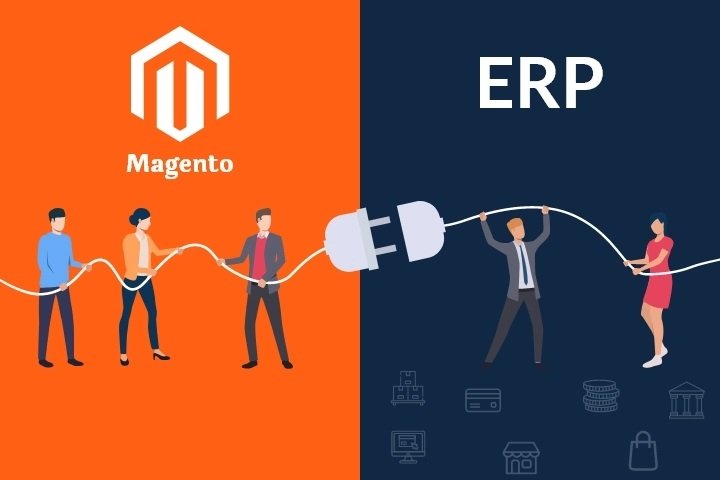
Connecting ERP with Magento has many benefits for the business.
Sage: Sage is a global company with various ERP and accounting software solutions used by both B2B and B2C companies. Each platform is a suite of business software that offers a single solution for managing your core business processes, including inventory, sales, customer service, finance and more. Sage ERP and Magento work together and can be customized to your needs, making it easier and faster to run your business.
Microsoft Dynamics 365 for Finance and Operations: This platform, formerly known as Dynamics AX, supports international operations conducted across multiple sites, and provides ancillary support for critical business functions such as finance, human resources, and operations management. Of course, this product also supports e-commerce-related processes, including inventory database integration and shipping and fulfillment management. Dynamics 365 Finance and Operations is primarily an on-premise solution, meaning it must be used with servers owned and operated by the customer.
NetSuite: NetSuite specializes in cloud-based ERP and business intelligence solutions for mid-sized organizations. The platform supports multiple e-commerce features, including sharing customer and product data and creating queues, which can be controlled through Magento. The ERP is also popular because of its open-source Magento integration connector, which developers can customize to suit their companies’ needs.
Vendors are not limited to choosing between these ERP products, as there are many other options available. Finding the right ERP solution is what ultimately matters most.
ERP connection with Magento store.
For the successful integration of any ERP software with a Magento store, choosing the right developer is crucial. To choose the most suitable one, one can consult a recent article, “Choosing a Magento Developer“". However, the connection of the ERP with the Magento store must be flawless for the proper functioning of the business.
After thousands of man-hours on the flexible Magento platform, Fixit.gr managed to create the correct connection between the Magento eshop and the ERP program in the business (ERP Integration).
This is how it was created Fixit ERP Integrator to meet all needs in this area.
It is a mediation system that perfectly unites the two programs. It is flexible, efficient and allows connection to any data format including Web Services, XML, CSV, and others. Fixit ERP Integrator is immediately available, adapts to the needs of the business and has been tested in practice in dozens of Magento eshops.
Even though the Fixit ERP Integrator is an already structured and tested system, it does not lose its flexibility. This means that it can be dynamically configured to fully meet the requirements of any ERP and effectively connect it to the Magento eshop.
Features of Fixit ERP Integrator at a glance:
- Tested and tested in dozens of eshop.
- Immediately available.
- Customizable to all ERPs.
- Compatible with SAP, Dynamic, Sage, JDE, System 21, Navision, Elucid, Protex, and many more.
- Dynamic and flexible.
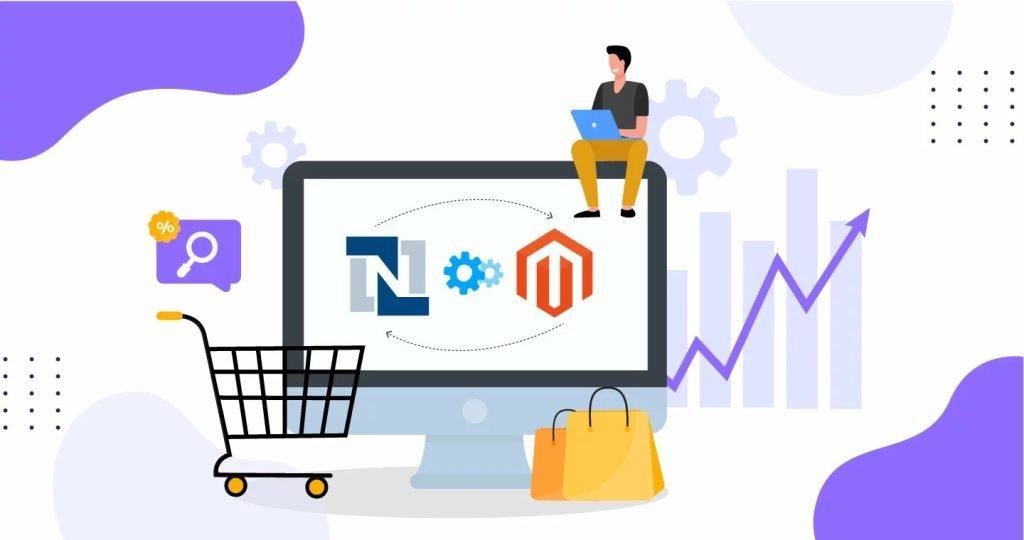
Increasing sales and managing inventory are some of the reasons for connecting ERP to your Magento store.
- Basic functions of an ERP.
Modern ERP platforms come with countless features. However, not all of these system components are created equal (some contribute to critical e-commerce processes, while others are built to collect feedback during sales demonstrations). Sellers need to learn to distinguish between these two dominant feature archetypes and focus on the modules of the platform that make a difference when combined with Magento. These include:
Inventory management: Especially these days, Magento store owners need to find a balance between being ready to meet customer demand and being economical. ERP inventory management features can help retailers find this middle ground, facilitating big-picture planning and addressing the tiny variables that can affect inventory levels.
Order management: ERP technology can transform order management, which is among the most difficult backend tasks for modern retailers. Most platforms can adequately automate this function and connect warehouse data feeds to Magento so that product pages are automatically updated when new inventory is scanned. However, sometimes sellers choose not to use this particular platform feature.
Business intelligence: Although ERP systems are known for their non-stop functionality, they actually have much greater potential thanks to the use of data collection. Retail decision makers can mine ERP data streams to develop long-term forecasts and coordinate important organizational moves. This is why most vendors offer business intelligence functions alongside the traditional modules mentioned above.
- Expense control.
ERP integration with Magento can come with significant costs, especially for e-commerce store owners implementing completely new systems. Many variables affect this amount, including business process customization and data migration. There are also some so-called hidden costs that tend to inflate the cost of ERP implementation, starting with the custom code. Vendors typically charge extra for custom components of the platform. While small customizations usually don’t require a large budget increase, larger ERP customizations that affect between 25% and 100% of ERP source code can have significant financial implications.
Epilogue.
Undoubtedly, connecting an ERP program to the Magento store has endless benefits. Specifically, for medium and large stores, ERP integration is equally important for the uninterrupted operation of the eshop. The appropriate choice of an ERP is therefore one side of the coin, as well as the correct integration plays an equally important role. A Magento store owner should therefore know the cost, benefits and basic functions of the ERP program, the choice of the appropriate one and finally achieve its correct integration with the Magento eshop.