
Introduction
The digital economy of 2026 is characterized by the deep integration of Artificial Intelligence (AI) into the daily operations of e-shops. However, as the algorithms become smarter, the data protection requirements become stricter. The relationship between GDPR and AI is not competitive; it is interrelated. For e-shop owners, understanding how to leverage AI while maintaining full compliance is now critical to survival and growth. In this article, we examine how Fixit EE helps businesses implement AI solutions safely and legally.
The new landscape: How AI is changing the definition of data
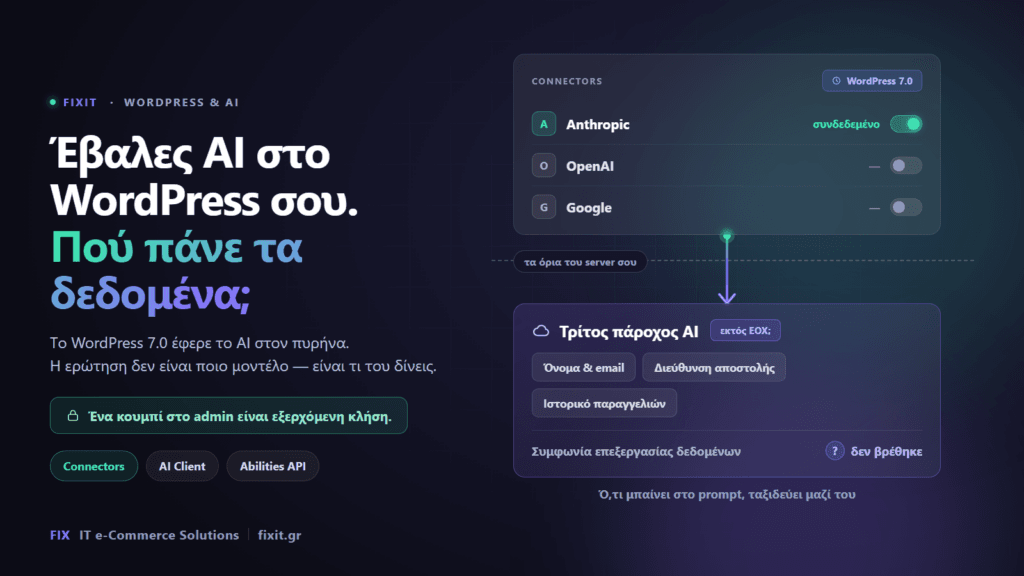
Artificial Intelligence, especially its advanced forms such as AI Agents and Large Language Models (LLMs), processes data in a way that traditional controls struggle to keep up with. In 2026, data collection is not just limited to names and addresses, but includes behavioral patterns, sentiment analysis, and preference predictions.
From static collection to dynamic prediction
Unlike traditional systems that store data for future use, AI systems generate new data through analysis. A customer support chatbot doesn’t simply answer from a knowledge base, but instead synthesizes answers based on thousands of previous interactions. This creates a new type of data: “derived data.” According to the European Commission’s guidelines, the processing of this data requires transparency and control so that the customer’s right to privacy is not violated.
The challenges of transparency and explainability
One of the key benefits of GDPR is the right to an explanation. When an AI system rejects an order or recommends a product, the customer has the right to know why. Algorithmic “black boxes” are now a compliance risk. Businesses need to ensure that decisions made with the help of AI are understandable and reasoned, not just random outcomes.
Advice: Don’t treat AI as a magical tool that works autonomously. Before implementation, conduct a data protection impact assessment (DPIA) specifically for how the AI model will handle personal data.
Compliance strategies for e-shops with AI
GDPR compliance in the AI environment requires technology solutions that incorporate data protection by design (Privacy by Design). Fixit EE proposes an approach that combines modern e-commerce platforms with specialized privacy management tools.
Consent management and cookie consent
The basis for compliance remains valid consent. However, with AI, this management needs to be more granular. Users need to be able to choose how their data is used for AI training purposes, beyond simple site functionality. Here, tools like WordPress Cookie Notice (GDPR) play a crucial role, allowing administrators to define precisely what data is collected and how it is managed, ensuring that consent is specific and up-to-date.
Data Security in Custom MCP Servers and Chatbots
Using Custom MCP (Model Context Protocol) servers allows businesses to control how LLMs access their data. Instead of sending data to public models, businesses can create local contexts or secure connections via APIs. This drastically reduces the risk of sensitive information being leaked. The development of such solutions, such as Fixit’s Chatbots, focuses on local data processing, keeping the sensitivity of information within the business ecosystem.
Practical application: Platforms and tools
Implementing AI strategies with compliance requires choosing the right technology infrastructure. Magento and WooCommerce platforms, when configured correctly, offer the necessary tools to control the flow of data.
AI integration in Magento and WooCommerce
The e-shop platform acts as the control center. Through custom plugins and APIs, AI tools that work in real time can be integrated. For example, an AI sales assistant can analyze the shopping cart to recommend products, but without storing personal data on external servers unless the customer has explicitly agreed to it. The architecture must ensure that data remains encrypted during transport and storage.
The role of automation in compliance
E-commerce automation can be used not only for sales, but also for compliance. Systems that automatically check the expiration of consents, delete data upon user request (Right to be Forgotten) and generate compliance reports are now essential. Using automation tools saves time and reduces human error, which is a common cause of data breaches.
Comparison Table: Traditional Approach vs AI with Compliance
The table below summarizes the key differences in the approach to data management in a modern e-commerce environment.
| Parameter | Traditional Approach | AI with Compliance (GDPR Ready) |
|---|---|---|
| Data collection | Bulk collection without separation | Selective collection based on purpose (Purpose Limitation) |
| Edit | Static analysis of historical data | Predictive analysis with algorithm transparency |
| Consent | General cookie acceptance button | Detailed preference management (e.g. via WordPress Cookie Notice) |
| Right to Deletion | Manual deletion from databases | Automated deletion from all AI systems |
| Safety | Firefighting approach (post-incident response) | Privacy by Design |
It is important to note that compliance is not a static goal, but an ongoing process. For more details on how to ensure your e-shop meets the requirements, you can visit our guide: Are you GDPR compliant?;.
Conclusion and Next Steps
The coexistence of GDPR and Artificial Intelligence in 2026 is not an obstacle, but an opportunity to build trust. Consumers prefer businesses that respect their data and use technology responsibly. Fixit EE is ready to help you implement custom AI solutions, from MCP servers to smart chatbots, guaranteeing full compliance with Greek and European legislation.
Don’t leave security and compliance to chance. Contact us today to analyze your e-commerce needs and design an AI strategy that increases performance while ensuring your customers are protected.