Introduction
When we show Talo to customers, the first question is almost always the same: «does it understand Greek?» The short answer is yes. The long answer is that «it understands Greek» hides five or six different problems, none of which are solved by choosing a more expensive model.
If you're thinking about putting AI into your eShop service, it's worth knowing exactly where it stumbles — because that's where sales are lost, not in impressive demos.
The first obstacle: the client does not write "correct" Greek
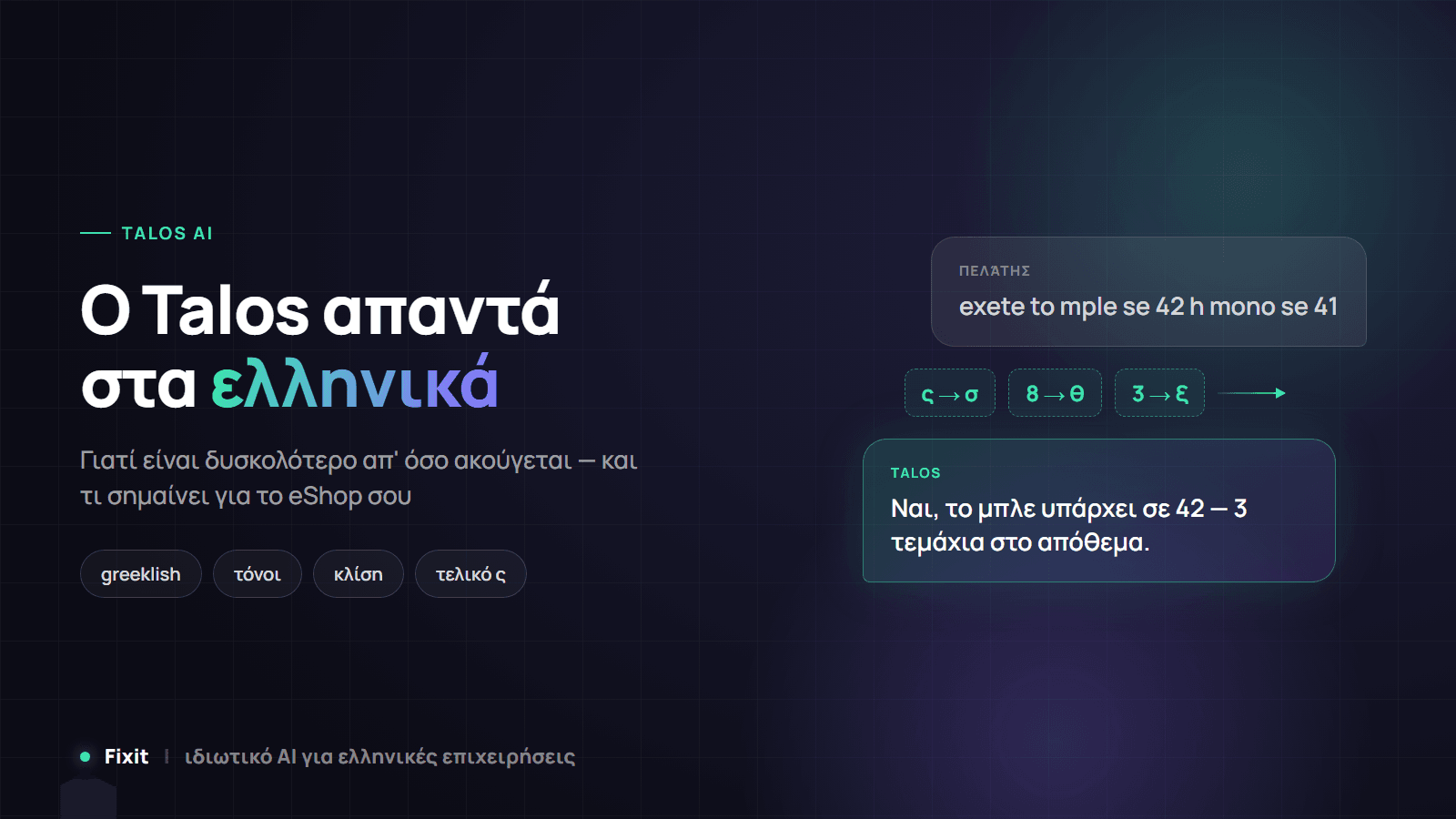
In demos, the question is always clear: «What is your return policy?» In fact, the chat accepts this:
«"exete to mple se 42 h mono se 41"»
No punctuation, zero accents, Greeklish, abbreviations, and a question that is actually two. A system that expects pure Greek answers here «I didn’t understand your question» — and the customer leaves. The goal isn’t to understand the language; it’s to understand How Greek customers really type on their mobile phones.
Greeklish: a language without a standard
Greeklish doesn't have rules. It has habits. The same word is spelled four or five ways, depending on the age and habit of each person:
shoes → papoutsia, papoytsia, papoutsja, papoutsa, pap8outsia
unlocking → xekleidoma, xekleidwma, 3ekleidoma
«θ» becomes th or 8. «ξ» becomes x, ks or 3. «ω» becomes o or w. There is no right way — there is only what the customer typed at that moment. A system that doesn’t transliterate Greeklish to Greek (in both directions) simply won’t find the product you already have in stock.
This is not theory for us: it is precisely the work we have already done in AmazingSearch, the smart search we built for WooCommerce and Magento, where Greeklish transliteration and manual synonyms are the biggest part of the value.

The tone that changes the entire question
In Greek, a tone is not decorative. It changes the word:
When Is my order coming? (question about time)
he didn't come When my order (complaint)
Two completely different situations, same letters. And since almost no one puts accents in chat, the system has to figure out the difference from context — not from spelling. The same goes for «ό,τι» and «οτι», for «μας» and «μας», and for any word written in capital letters: ΠΟΤΕ, ΠΑΡΑΛΑΒΙ, ΑΚΥΡΟΣΙ — capital letters in Greek lose the accent by default.
There is also a more insidious trap: the final sigma. «order» and «orders» are two different characters (s and s) to the computer, and therefore two different words. If it is not normalized, the search returns empty for a reason that no one will ever guess by looking at the screen.
One word, ten forms
English has two or three forms per noun. Greek has dozens, because everything is inflected: nouns, adjectives, articles, numerals.
the shoe, the shoe, the shoes, the shoes, the shoes, the shoes
Your catalog says «Men’s leather ankle boots.» The customer asks, «Do you have men’s leather ankle boots?» To a human, it’s obviously the same. To a system that searches by word, it’s not—unless someone has taught the machine that all of these forms point to the same thing.
Half English in Greek
The Greek e-commerce customer speaks a mixed language, and does so without thinking about it:
«"I checked out but didn't receive a confirmation, should I refresh or try again with another card?"»
In one sentence: English terms with a Greek inflection («I checked out»), technical jargon, and a question that hides anxiety about a payment. The system needs to understand both languages at once, not respond in English because it saw English words, and recognize that a general answer is not enough here — it needs real verification of the order.
The hidden cost that no one discusses
There is also a purely economic aspect. Language models don't read words — they break the text into pieces (tokens). English, which dominates the training data, breaks very economically. Greek breaks into significantly more pieces for the same meaning.
In practice, this means three things: each Greek conversation costs more than the corresponding English one, less content fits in the conversation's "memory", and responses are slower. It's one of the reasons why a cloud chatbot with a per-use fee charges a different bill in Greece than what the English pricing page promises.
Why it's not solved with a "better model"«
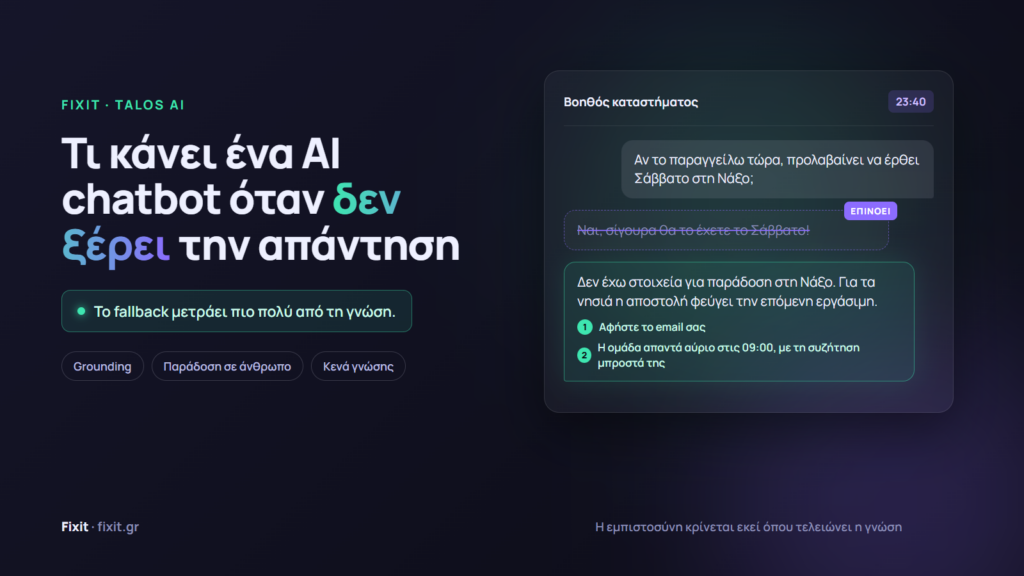
Here's where we want to be honest. Modern models speak Greek just fine — that's not the problem. The problem is that they don't know your data.
A model who doesn't see your catalog has no way of knowing if you have the blue in 42. She'll answer anyway — politely, in impeccable Greek, and probably wrong. The language was perfect; the information was fantastic. For a customer waiting for their order, that's worse than "I don't know.".
The difference, then, is not how well the system speaks Greek. It is Where does he get the answer from?: from his general knowledge or from your own database, your own inventory, your own policies.
What does this mean in practice?
If you're evaluating an AI solution for a Greek eShop, try it like this:
Write Greeklish. Without accents, with mistakes, as the customer writes on the bus.
Ask something that changes daily. Stock, delivery time, order status. If it doesn't know, it's not connected to anything.
Ask something he doesn't know. The correct system says "I don't know, I'm connecting you to a human." The dangerous one invents.
Mix up the languages. See if he'll answer you in English because you said "checkout.".
How do we approach it?
Ο Talos was built from the ground up for Greek businesses — and the key design decision wasn’t linguistic, it was architectural: it runs on a private server, reads your own data, and nothing leaves your infrastructure. It’s not a chatbot with a Greek menu; it’s a private AI ecosystem around your own business, with its own products, policies, and terminology.
Because ultimately, the Greek language is only half the problem. The other half is responding based on the truth of your business — and no language solves that, connecting to the right data solves it.
If you want to see how Talos would respond to your own customers, with your own catalog, talk to us.