Introduction
E-commerce order management has been transforming rapidly in recent years, as businesses seek ways to reduce operational overhead and improve customer experience. At the heart of this transformation are AI Agents: digital entities that act as "intelligent assistants," taking over processes that until recently required constant human intervention. In the field of order management, AI Agents function as an intermediary mechanism between the e-commerce platform (Magento, WooCommerce, or others), the ERP system, and the chatbot, providing automated support throughout the entire lifecycle of an order.
In a business environment, this technology enables immediate customer updates on order status, automated data retrieval from the ERP, product availability checks, shipment tracking, resolution of frequently asked questions, and support for after-sales processes, all without requiring the constant involvement of support teams. Operation is carried out through secure integration with existing infrastructure, where the AI Agent retrieves data from the ERP and delivers it back to the customer via chatbot in a natural, accurate, and direct manner.
This guide presents the operation of AI Order Management Agents, providing an understanding of how they are practically utilized in modern e-commerce systems, how they are integrated into Magento and WooCommerce, how they communicate with the ERP, and what benefits they create for businesses and customers.
What is considered an AI Agent in order management
An AI Agent is described as an autonomous digital mechanism designed to perform functions without human guidance, utilizing artificial intelligence, natural language, and secure access to data. In order management, the AI Agent acts as a hub that:
- retrieves order data,
- reads invoices and shipments,
- searches customers details,
- checks product status,
- identifies pending tasks in the ERP,
- automatically responds to questions submitted via chatbot.
Operation is based on rules and natural language models. When a customer contacts the chatbot asking "Where is my order?", "When will it be shipped?", "Is the product I want available?", or "Can the address be changed?", the AI Agent is the one that performs the search across the systems, extracts the information, and delivers it back to the user in a comprehensible format.
Thus, support is transformed into an automated process, as the AI entity functions as a digital employee that has access to all the necessary data and manages it with consistency.
How the AI Agent integrates into Magento and WooCommerce
The Magento and WooCommerce platforms are extensively used in the Greek and international e-commerce markets. They are the foundation for the majority of businesses seeking full customization freedom, ERP integration, and growth potential. The integration of AI Agents into these platforms is carried out in a manner fully compatible with existing structures, without altering the way the e-shop operates.
Existing architecture
In Magento and WooCommerce, the order is recorded in the e-commerce system and is then automatically transferred to the ERP, where:
- the invoice is issued,
- the stock is updated,
- the shipment is scheduled,
- the logistics are recorded.
The AI Agent is positioned at the final stage of information, specifically at the point where data has been finalized in the ERP. Instead of the customer seeking support via phone or email, the AI Agent takes over to respond in real-time to all inquiries related to the order flow.
Integration with APIs without code changes
The connection is established through the platforms' existing APIs. In Magento, endpoints are used to allow the retrieval of orders, tracking numbers, and customer data. In WooCommerce, native REST APIs are utilized to read the same information. No changes are required to the e-shop's architecture; existing mechanisms are fully leveraged.
In this way, the AI Agent gains the ability to access each user's real order data securely, without the AI entity having direct access to sensitive systems. Communication always takes place through an intermediary layer that ensures the control of permissions and authorized actions.
The importance of ERP integration
The operation of the AI Agent is based on its communication with the ERP, as the ERP holds the final truth regarding the progress of every order. Updates, execution, and invoicing all take place within the ERP, which serves as the primary source for the answers provided to customers.
Types of information used by the AI Agent
Among the key pieces of information extracted from the ERP are:
- Order status (pending, processing, shipped, delivered).
- The tracking number and the carrier.
- The invoice (or billing document) and the date of issue.
- The payment status.
- Any pending items, such as products that have not yet been reserved.
- Product replacement availability.
- Information regarding exchanges, returns, or cancellations.
The AI Agent does not create or modify orders; it operates in a passive manner. It retrieves information, processes it, and transforms it into responses displayed within the chatbot. In this way, the customer receives immediate updates on the status they are interested in.
Avoiding errors and delays
In a business environment, delays in order updates often create communication overhead and friction. Through automation, the customer is informed instantly about their parcel's progress, without the need to wait on a phone line or send an email. At the same time, the business is relieved of a significant portion of support costs, as typically 60–80% of inquiries concern issues that can be resolved without human intervention.
Operation via Chatbot
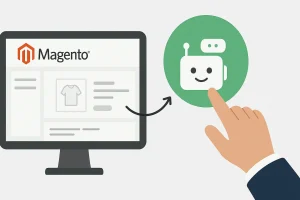
The chatbot serves as the interface through which the customer interacts. The AI Agent operates in the background, without the user perceiving its existence.
How the User Experience is Shaped
The customer interacts with the chatbot naturally, phrasing their inquiries in everyday language. The AI Agent decodes the content of the question, identifies exactly what is being requested, and proceeds to retrieve the necessary information. To the customer, the process appears as a simple conversation, while in the background, a complex data flow is being executed.
This experience is considered particularly significant, as it allows the customer to receive an answer without needing to know order numbers, without navigating through complex dashboards, and without having to wait for a human representative.
Everyday Usage Examples
Common questions that are answered automatically include:
- What stage is my order in?
- Has my parcel been shipped?
- Can I change my address?
- Is there stock available so I can add another product?
- «When will I receive it?»
- Is there a carrier delay?
- Can I cancel?
- «How do I make a return?»
In all of the above, the responses are based on real-time ERP data rather than generic information. This ensures the customer receives personalized support, strictly tailored to their specific order.
Explanation of Operation
Although the operation of an AI Agent is based on complex mechanisms, its business application can be described without technical jargon. In summary, the process works as follows:
- The e-shop receives the order.
- The ERP is updated and provides the actual execution progress of the order.
- The AI Agent is automatically updated for every change that occurs within the ERP.
- The customer addresses the chatbot.
- The AI Agent responds based on the data it retrieves from the ERP.
This operation requires no changes to the business's daily procedures. The way invoicing, shipping, and internal updates are handled remains exactly the same. The only difference is that the customer now receives an immediate response the moment they request information.
Improvement of Service and Customer Experience
The consumer experience is a critical factor in e-commerce. Providing immediate and accurate information regarding order status significantly increases user trust and reduces the negative emotions caused by uncertainty. The use of AI Agents in customer service creates an experience characterized by:
- Immediacy
- Consistency
- 24/7 Availability
- Gemini said Personalization of Responses
- Gemini said Uniformity of Information
These characteristics significantly contribute to enhancing the brand image and building a more stable relationship of trust between the customer and the e-shop.
The Importance of After-Sales
Order management does not end with the shipment of the parcel. After-sales issues are a significant part of the overall experience. After-sales includes:
- Updates on Delays
- Questions regarding changes or returns
- Requests for duplicate documents
- Management of defective products
The AI Agent assists in managing this process by answering a large percentage of queries automatically and informing the customer about the steps they need to follow. This significantly reduces the workload of the support department, while ensuring that the customer is guided with clarity and consistency.
Cost and Operational Load Reduction
The adoption of AI Agents in order management reduces the need for human intervention in a large percentage of support requests. In most businesses, 60–80% of requests relate to issues that the AI Agent can cover automatically. This reduction creates:
- Less pressure on the support department
- Reduced need for extra staff during peak periods
- Lower total cost of service
- Faster response times
- Ability for the team to focus on more complex issues
The benefit is particularly felt during periods of high demand, such as Black Friday, holidays, or major promotional events, where the volume of requests increases significantly.
Compliance and data security
The use of AI Agents in order management operates in a manner compatible with existing security and data protection standards. Data access is performed through secure mechanisms, with predefined permissions and restrictions. The AI Agent does not store personal data; it acts as an intermediary that retrieves information and presents it during the current session. Thus, the following principles are maintained:
- Access limitation
- Data minimization
- Temporary processing
- Communication security
Compliance with these standards is a key factor in evaluating such systems, especially in businesses that handle data in large volumes or in environments with strict regulatory requirements.
Integration into existing processes without reorganization
One of the greatest advantages of AI Agents is that they integrate into existing processes without requiring a restructuring of workflows. The ERP, Magento or WooCommerce, and the warehouse continue to operate in the same way. The AI Agent does not alter the supply chain, does not change the invoicing method, and does not affect accounting data.
Through smooth integration, the business avoids the need to train employees in new procedures. The only requirement is informing the support team that a large portion of queries will now be answered automatically.
Sales, cross-selling, and product recommendations

AI Agents are not limited to answering order-related questions. By accessing purchase data, preferences, and history, they can provide product recommendations related to the order, acting as a supportive cross-selling mechanism. Examples where this function is considered useful include:
- Related product suggestions when the customer asks about delivery
- information about additional accessories,
- Communication for future discounts linked to a previous purchase
In this way, the AI Agent evolves from a simple support tool into a strategic growth engine for the business. It bridges the gap between customer service and proactive sales.
Increased Trust and Transparency
Direct access to real-time order data contributes to greater transparency in the customer-business relationship. At any given moment, the user knows:
- When the order was placed,
- when it was invoiced,
- when it was shipped,
- which carrier has handled it,
- at what stage of progress it currently stands,
- when it will be delivered.
This transparency reduces customer anxiety and increases satisfaction with the overall purchasing experience. In a highly competitive environment, clear and accurate information serves as a significant competitive differentiator.
Application in B2B Environments
The use of AI Agents in order management is not limited to B2C. In B2B environments, where orders are often larger, more complex, and subject to specific pricing terms, AI Agents play a crucial role.Examples of where this functionality is particularly valuable include:
- Availability checks for wholesale orders,
- credit balance updates,
- factoring limits,
- status of large-volume orders,
- update on backorders.
In such environments, the need for automated updates is considered even more critical, as the time of sales representatives and support teams is highly valuable and often insufficient for immediate response.
Scalability and Future Capabilities
The AI Agents currently used for order management are still in their early stages, but their evolution is continuous. As artificial intelligence models mature, features such as the following are expected to be integrated:
- predictive delay alerts for shipments,
- delivery time estimation based on carrier patterns,
- real-time identification of potential issues,
- automated CRM alert generation for follow-up,
- automated customer notifications for significant changes,
- smart request grouping based on sentiment analysis.
With the addition of these functionalities, the AI Agent is transformed from a simple support tool into an integral part of the e-commerce operational backbone.
Conclusion
This powerful conclusion perfectly encapsulates the strategic value of AI Agents. You’ve highlighted the most critical advantage: seamless integration without infrastructure overhauls. By acting as an intelligent "middleware" between existing platforms (Magento, WooCommerce, ERP) and the end-user, AI Agents turn static data into a dynamic conversational experience.
This technology is emerging as a decisive tool for businesses that wish to operate more efficiently, reduce response times, and create high-quality experiences with almost no human intervention.
Transitioning to automated order management with AI Agents is now considered a critical step for businesses seeking greater efficiency and competitiveness. In this context, the evaluation of existing infrastructure and the seamless integration of AI Agents into Magento, WooCommerce, and ERP systems can be entrusted to the specialized team at Fixit.gr, which possesses extensive experience in e-commerce solutions, ERP systems, and artificial intelligence applications.
By communicating with Fixit.gr, a detailed mapping of processes can be requested, suitable automation flows can be proposed, and AI Agents can be implemented to operate with precision and consistency in daily business operations.