Differences between upgrading, updating and migrating to Magento.
Support for Magento 1 has been discontinued by Adobe Commerce and its latest version, Magento 2 has been adopted by most merchants. The decision to continue using Magento 1 is due to one fact. The main reason is that when they are in their comfort zone, as it is always a challenge for them to switch and explore alternative options.
The importance of website performance is crucial as it directly affects the user experience, as is well known. Using Magento 1, you are likely to encounter issues such as poor performance, security vulnerabilities, the high cost of custom development and many more. These issues can lead to PCI compliance issues, exposing you to significant fines and legal complications.
This is why it is highly recommended for Magento store owners to migrate to Magento 2 as soon as possible! It is important to understand the in-depth differences between upgrading, updating and migrating to Magento.
What is PCI and how does it relate to the transition to Magento 2?;
The Payment Card Industry Data Security Standard (PCI DSS), is an international security standard that applies to businesses and organizations that accept, process, store, or transmit payment card data. PCI DSS is designed to protect payment card information and prevent fraud and security breaches.
This model applies to all businesses and organizations connected to the payment card payment platform, regardless of their size or the type of transactions they carry out. The standard includes requirements for network, systems, applications and data security, as well as for the security procedures and policies that must be followed.
Businesses and organizations regulated by PCI DSS are required to strictly adhere to the requirements of the standard and undergo repeated security audits to ensure their compliance. Failure to comply with PCI DSS can have serious consequences, such as loss of consumer confidence, loss of business reputation, legal implications and high financial penalties.
PCI DSS provides significant protection for payment card data and is a critical tool for preventing and addressing potential security breaches and data losses.
Thus, one understands how crucial the transition to Magento 2, as one of its main features is the elimination of security gaps, in addition to the increased efficiency of the website.
Upgrade or update Magento?;

In general, the usage of the terms “Magento upgrade” and “Magento update” can vary significantly between platforms, with people typically using the term “Magento upgrade” to refer to the process of upgrading the Magento platform from one version to another (e.g. from Magento 2.4.1 to 2.4.5). On the other hand, “Magento update” is used to describe the act of updating themes, extensions and language packs within Magento.
However, since Adobe Commerce does not explicitly distinguish between these terms, it can generally be assumed that the terms “upgrade” and “update” can be used interchangeably in most cases and describe essentially the same thing. All minor or incremental version changes can be referred to as either “upgrades” or “updates.”.
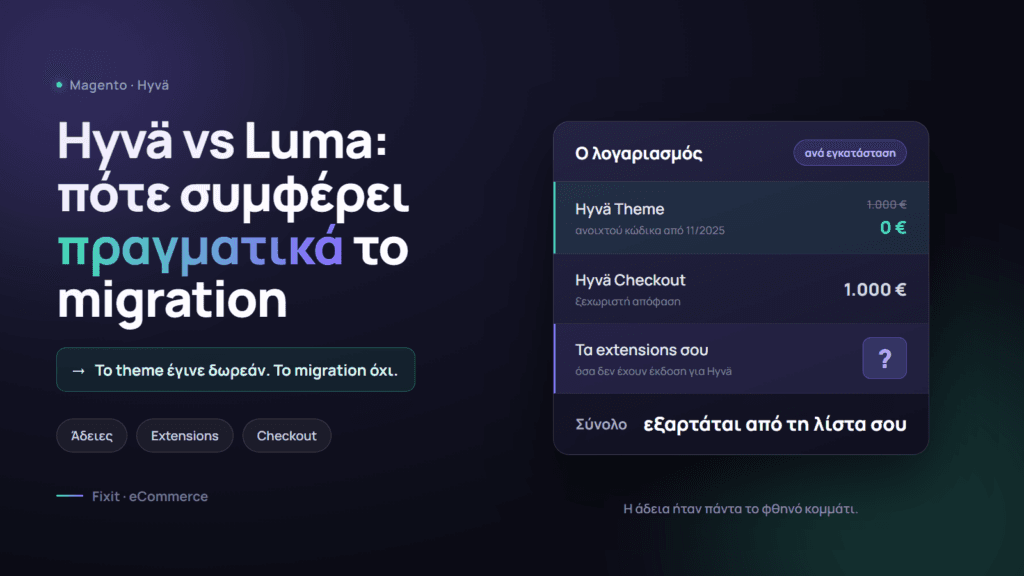
A common mistake that many people make is using the term “Magento upgrade” when referring to the transition from Magento 1 to Magento 2. This is incorrect. In such cases, the appropriate term to use is “Magento 2 migration”. With upgrading or updating a Magento website, many benefits are achieved, such as:
- New features and functions: Each release introduces a series of new features and functionalities that facilitate more efficient management of your Magento website, eliminating the need for additional third-party integrations.
- Performance improvements: Adobe Commerce strives to improve the functionality and overall performance of the platform with each release. This can result in optimized site speeds, faster asset load times, and more.
- Security improvements: Magento updates address security concerns by addressing the latest patches for the site. These patches fix important bugs and resolve security issues, thereby minimizing the risks of hacks, cyber attacks, or an unstable e-commerce store.
Upgrading your Magento 2 store to the latest version is a relatively straightforward process that is not as complicated as migrating from Magento 1 to 2. However, without sufficient technical expertise, there is a risk of data loss. Therefore, it is recommended to seek the help of experts.
In the fixit.gr, our team of experienced developers can help assess the requirements for migrating, upgrading or updating your Magento website. Their expertise allows for specialized guidance in choosing the appropriate course of action based on the individual needs of each business. Leveraging their knowledge and skills, a smooth and successful migration or improvement of your Magento website is ensured.
Switch to Magento 2.
Magento migration is a process where the store is moved from Magento 1 to Magento 2 or from another CMS (Content Management System) or platform to Magento. This step involves permanently transferring the website data to Magento 2.
During the migration from Magento 1 to Magento 2, various benefits can be obtained, including:
- Improving website performance – It should be noted that the frontend performance of Magento 2 is overall approximately 50% faster, while the checkout process is 38% faster compared to its predecessor. By migrating the website to Magento 2, significant improvements in store performance can be observed, thus improving the customer experience.
- Improving the admin interface – Magento 2’s user-friendliness has been significantly improved, catering to both platform experts and non-expert users. This feature allows for better focus and facilitates faster and more efficient usage.
- Add security features – Magento 2 offers superior security features compared to Magento 1, including improved password management, two-factor authentication, and a comprehensive backup plan.
- Reduced conflicts with extensions – When using Magento 2, compatibility issues with various extensions from different third-party vendors are significantly minimized.
- Promoting mobile friendliness – Magento 2 prioritizes mobile commerce, while Magento 1 does not perform optimally on mobile devices.
- Access to Magento 2 support and the latest updates – Magento 1 support ended on June 30, 2020, meaning no further security or feature updates are provided.
By choosing to migrate to Magento 2, these advantages are leveraged, ensuring a more efficient and secure platform for your e-commerce store.
Main differences between Magento upgrade, update and migration.
Simply put, the introduction of new features, upgrades, or other improvements is included in a Magento upgrade (or update), while migration means moving from a previous system to a new one.
The table below presents a summary of the aforementioned explanations, facilitating a clear understanding of the distinctions between Magento upgrade, update, and migration.
| Magento Upgrade (Update) | Magento migration | |
|---|---|---|
| Definition | It refers to all minor or incremental version changes. | Refers to the migration process from Magento 1 to Magento 2 |
| Example | from Magento 2.4.1 to 2.4.5 | from Magento 1.xx to 2.xx |
| Benefits | -Add new features & functions -Improving performance -Improvement of security features | – Improving website performance – Improved admin interface – Adding more security features – Minimizing conflicts with extensions – Promoting mobile friendliness – Magento 2 support & latest updates |
Epilogue.
Magento 2 has the potential to empower businesses of all sizes, positioning it as a valuable platform for upgrading, updating, or migrating your e-commerce store. By performing these actions, store performance can be improved, resulting in increased sales.