There is no greater battle when it comes to choosing a platform for an online business. As the demands of the public increasingly evolve, the adaptability of an eCommerce site is a primary goal. However, to choose a platform, one must fully understand their advantages and disadvantages. Magento vs WooCommerce. Which one prevails?;
Magento advantages.
“In a previous article, we mentioned the advantages of creating an e-shop with this particular platform. “9 reasons to create an e-shop with Magento”. "Although cost was placed over advantages back then, for setting up a profitable business in reality, Magento is not among the cheap options."”
- The potential of building an online business based on Magento is extraordinary.
- It provides search engine optimization, which elevates the business to the top positions.
- It is mobile-friendly, which is of utmost importance these days.
- Its adaptability, with its specialized modules, offers a top user experience and personalized capabilities.
“Specifically for Magento modules, there is more information in a previous article. How important are Magento Modules?;“
- Possibility of evolution and development in future needs, one of its main advantages Magento.
- The trust of large companies with global capacity and action.
- Adaptability of APIs. Thus, the need to update an ERP, for example, is done automatically, as is the connection of any other program that may be required.
- Product editing and advanced search.
- Payment methods, shipping and cost calculation.
- The performance of the eCommerce page reaches the level of perfection, from response times, content quality and options.
The great battle for building an e-shop.
Magento Disadvantages.
While it is a platform that is constantly gaining ground, the reason that still keeps it grounded as an option is the cost. Regarding professional development, in addition to requiring programming knowledge, it is not suitable for use by inexperienced users. The option of developer support is mandatory if Magento is chosen. The cost is also increased by the use of modules as they are specialized for use, but also more efficient.
The use of WooCommerce in e-shops.
On the other side, WooCommerce. This platform essentially offers what Magento can't, but it can't match it in terms of efficiency. Thus, it aims for ease of use and low cost to become the most preferred platform for online businesses, which it largely succeeds in.
- The expansion of the business is done with extensions (plugins).
- Low development costs, extensions are mostly free.
- The page's themes are free or low-cost.
- Management can be done by non-qualified personnel.
- No programming knowledge is required.
- Easy product management.
- The payment processor is achieved simply with an extension.
“The main advantages of WooCommerce are mainly aimed at the financial aspect. It certainly has potential in several other areas, but it cannot reach Magento in terms of quality.”
The disadvantages of using WooCommerce.
WooCommerce is clearly aimed at small and medium-sized businesses. If your priorities are between easy management, low cost and personal engagement then WooCommerce is the way to go. However, it cannot support the scalability, adaptability and build quality that a Magento page offers.
“The main API function is the Woocommerce API, i.e. another plugin for this purpose. However, there are many problems with plugins, (incompatibilities, untimely updates, conflicts, etc.). This can be quite costly and serious for a business if it does not have the proper support from professionals.”

Use of various platforms for online businesses.
The security offered by both platforms.
The security of a business's website is a great factor in choosing the platform to build on. Thus, Magento and WooCommerce must be compared in this field as well, in order to declare the respective winner.

- WooCommerce. WooCommerce is a secure platform for building an e-commerce store. It provides continuous security updates to business owners and also notifies them if any action is required. Along with this, it also offers excellent extensions and security features to further enhance the security of the store.

- Magento. Magento is also a secure e-commerce platform that constantly provides new security patches. In addition, it also scans for vulnerabilities and provides security updates for older supported versions. It also offers built-in security features and extensions to further improve store security.
“Both platforms are extremely secure and there is no one that stands out as more secure. Perhaps due to the additional security options, Magento has a slight edge, but not to such a memorable extent.”
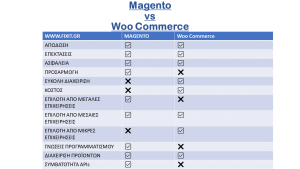
The advantages and disadvantages of WooCommerce and Magento.
What exclusively characterizes each platform?.
WooCommerce
WooCommerce is a powerful plugin for the WordPress platform. It offers all the features an e-commerce site requires, while maintaining the ease of use of the platform.
Magento
Magento is an e-commerce platform tailored for web development professionals from medium to large online stores. It offers one of the most robust feature sets in the industry, making it ideal for stores with high ambitions.
The comparison between the two platforms is beginning to be fleshed out, and the picture of which one prevails is becoming clearer.
Battle in individual sectors.
Beyond the main areas where the Magento vs. WooCommerce battle is focused, there are also subcategories that can be compared.
- Both platforms have no limit on the number of products on the website. You can add as many products as you need.
Magento offers powerful inventory management for large and complex product catalogs. Massive order management and multiple stores. B2B features Magento Commerce and Magento Commerce Cloud.
WooCommerce has weak inventory management for large and complex catalogs. Poor database architecture for managing high volume orders. Requires a plugin for multi-store management and B2B functionality.
- Possibility of coupons and special discounts.
With Magento, offers are flexibly defined for customer groups and based on list price or shopping cart price. Multiple coupon codes can also be applied to a single order.
WooCommerce also has this feature, but it is very basic and does not cover the needs and purposes of real-world use. Coupon codes are case-sensitive and are defined only based on product identifiers.
- SEO capabilities.
Magento is at the top of the SEO ladder. It has powerful features out of the box and provides many advanced extensions in case there are more complex requirements. With Magento’s power, a store will easily achieve high rankings in search engines and increase traffic attraction. On the other hand, WooCommerce inherits the SEO capability of the WordPress platform, so it also has quite good SEO capabilities, but not the maximum possible.
- Topics and standards.

Both platforms offer excellent themes.
The WooCommerce and Magento platforms provide a wide variety of templates and themes. Some simple themes are free. Of course, you can also find paid ones that are more advanced and customized to your needs.
In individual sectors, Magento clearly prevails as it is more powerful and its targets are large enterprises.
Response speed and performance.
A very important factor, especially when comparing two e-shop creation platforms, is response speed and performance.
Most visitors to a website will quickly abandon or not even return to purchase if the loading speed is slow. This causes a significant drop in potential revenue for a business.
However, regardless of the platform, website performance and speed depend on several aspects, including:
- The image displayed (optimized or not).
- The number of installed extensions.
- The quality of the web hosting provider.
Both platforms offer excellent website performance and responsiveness. There is no clear advantage for either.
Comparison in the field of support.
WooCommerce and Magento are both open source platforms that attract large numbers of development communities.
WooCommerce only provides support for paid extensions. For the open source Magento edition, support is available from the community or can be done by qualified developers. For the Commerce and Commerce Cloud editions, there is dedicated and direct support via ticket, email, and phone. Store owners who want to focus on their business choose a trusted Magento partner that offers e-commerce solutions, including native Magento POS, website creation, support, and operations.
Winner announcement.
Both platforms are quite powerful and efficient. After all of the above, choosing a winner is an extremely difficult task. This is mainly because they do not address the same audience. Thus, both winners are declared for the use that each one is targeting. If it is a store with high ambitions and great business expectations, the choice of Magento and specialized developers is mandatory. On the other hand, if it is a small and medium-sized store, which aims for low costs and at the same time business performance, then Woocommerce should be chosen. A tie.