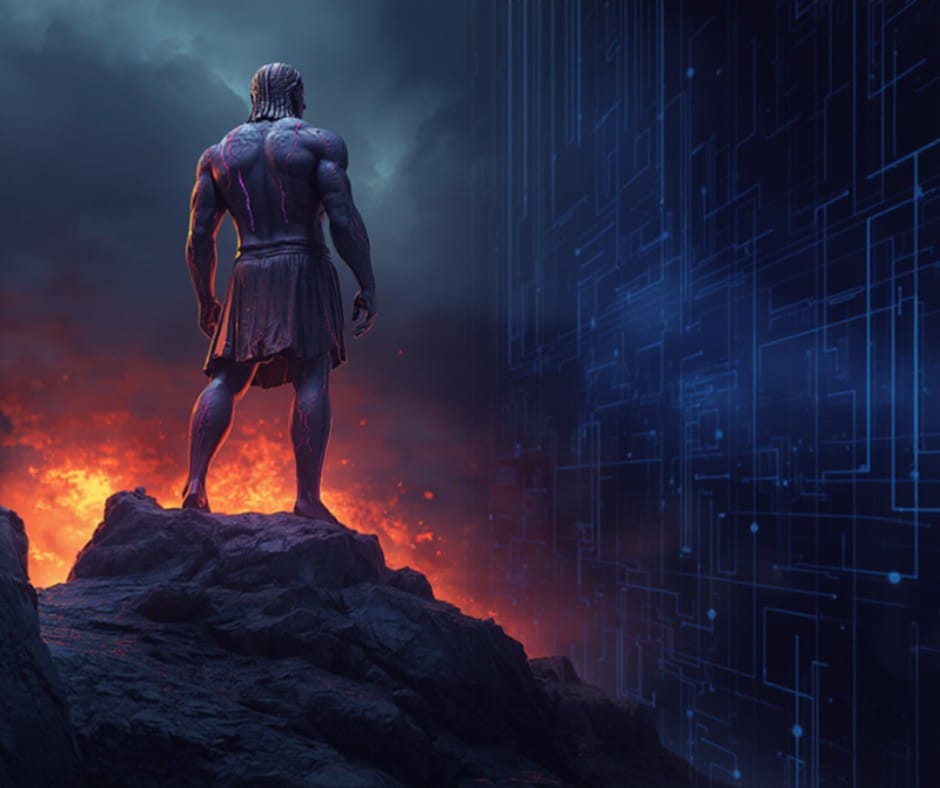
There are names that carry weight. Names that you don't choose randomly, but because something in them resonates with what you want to create. The name Talos is one of them. And its story begins not in some Silicon Valley, not in artificial intelligence labs, but in the forges of a god beneath the burning earth of ancient Greece — in his fiery workshop. Hephaestus.
Hephaestus and the Creation of Talos
In Greek mythology, Hephaestus was the god of fire, blacksmithing, and art. He was not a god of beauty or strength — he was the god of creation. Lame from birth, rejected by Olympus, he found his strength in the anvil and the hammer. He made armor for gods, chains for titans, palaces of gold — and a creature that would prove to be his most astonishing creation: the Talos.
According to legend, Talos was created from bronze — all of it, from head to toe, a huge humanoid creature with fire within him and intelligence in his gaze. Hephaestus gifted him to Zeus, who in turn gave it as a gift to Europa — and through her to her son, Minos, king of Crete. His mission was simple and clear: to guards the island.
The Guard of Crete: The Uninterrupted Patrol
What does it mean to guard an entire island? For Talos, that's exactly what this letter meant. Every day, without interruption, without rest, without hesitation — he did three periods around the coast of Crete. Three laps every day, with huge strides, with a gaze that covered the horizon, with automatic precision that no mortal guard could imitate.
If ships approached the coast without permission, Talos did not wait. He would gather huge rocks and hurl them at them from the shore, sinking the vessels before they could even plan to land. And if any enemies managed to reach land, Talos had another weapon: he could heat his bronze body until it turned red and burn the invaders in his arms.
He was at once a guard, a weapon, and a symbol — the embodiment of non-negotiable protection. No one approached Crete without his will.
The Ichor Vein: The Secret of Life
But every creation, even the most perfect, hides something vulnerable within it. For Talos, this secret was one: a single vein that runs through his entire body, from head to toe, filled with ichor — the blood of the gods, that which gives them immortality and life. At the end of the vein, in the ankle of the left foot, a bronze nail sealed everything.
The ichor was his source. Without it, Talos was nothing more than an empty bronze statue. This knowledge—where the strength lay, where the weakness lay—was the key. And once, some found it.
The Argonauts, Jason and Medea
Talos' greatest test came with the Argonauts. Jason and his heroic party, returning with the Golden Fleece, decided to stop at Crete. Talos did not invite them — he confronted them. Rocks were flying, waves were rising, and the Argo was forced to keep at a distance.
No Argonaut, not even Hercules if he were in the company, could defeat the bronze giant by force. He was defeated by Medea — the sorceress, the wise one, the one who understood the secrets of things. With her magic and cunning, she made Talos believe that she had granted him immortality. In the process, the bronze nail in his ankle was removed. The ichor poured out. And Talos, the invincible guardian, collapsed.
His fall was an earthquake. He did not die in battle—he died because the source of his knowledge was exhausted. The ichor was gone, and with it went what made him alive.
The First Robot in History
Modern historians and technology scholars have identified something amazing in Talos: it was the first recorded robot idea in human history. Three thousand years before Silicon Valley, before transistors, before machine learning, the Ancient Greeks had already imagined an autonomous mechanical being that:
- It operated continuously without human supervision.
- It performed a specific mission with mathematical repeatability
- He recognized friends and enemies
- Responded to threats automatically
- They were powered by a central source of “life”
It's not an exaggeration. It's philosophical precision. The Ancient Greeks didn't just have imagination — they had vision for technology. The word “automaton” is Greek (automaton = self-moving). And Talos was the first automaton — a being that moved on its own, for a purpose, without the need for human command at every step.
Aristotle would later say that if toolboxes could work by themselves, we wouldn't need slaves. Hephaestus didn't wait for Aristotle—he had already built it.
3,000-Year-Old Philosophy: The Idea of the Autonomous Machine
What does this mean for us today? Does it mean that the idea of autonomous, protective, tireless machine It's not something Silicon Valley invented. It's something that the human imagination — and especially the Greek imagination — had already dreamed of centuries ago. Talos was the answer to the question: “What would an invincible, untiring sentinel do if he never tired?”
This question hasn't changed. It's just that the answer today doesn't have copper — it has code. It doesn't run on shores — it runs on servers. It doesn't throw rocks — it sends answers in milliseconds. But the gist remains the same: an autonomous, intelligent creature that guards what you entrusted to it.
From Hephaestus to Fixit: How Talos AI Was Born
When the Fixit EE. decided to create an AI platform for e-commerce, the search for a name was not accidental. It needed a name that carried with it history, meaning, and identity. A name that immediately said what this tool did — without the need for explanation. And the Talos It fit perfectly.
Why the parallels are strikingly accurate:
- Hephaestus = Fixit. The craftsman god who creates with skill, with passion, with knowledge. We don't make armor — we make digital tools. But the philosophy is the same: every creation must be durable, intelligent, and intentional.
- The bronze body = AI technology. A body that doesn't get tired, doesn't get sick, doesn't have bad days. Talos' infrastructure — servers, APIs, language models — is the copper of the 21st century. Tough, reliable, always ready.
- Triple daily patrol = 24/7 availability. The mythological Talos didn't take time off. He didn't sleep. He didn't stop for coffee. Talos AI answers customer questions at 3 a.m., on weekends, on holidays — without human intervention.
- The ichor = the knowledge base. What kept Talos alive was the ichor — the divine essence within him. What keeps the Talos AI intelligent is the knowledge base every e-shop: products, policies, FAQs, order history. Without this knowledge, it is an empty tool. With it, it becomes a living partner.
- Guard of Crete = guard of your e-shop. Talos would not let any enemy into Crete. Talos AI leaves no customer question unanswered, no sales opportunity lost, no visitor left without direction.
“The First Robot in History Was Greek. We Made the Next One.”
This proposition is not bragging. It is a statement of identity. When Fixit chose the name Talos, it chose to connect with a tradition of Greek thought that began three millennia ago. Greece was not only about philosophers and poets — it was also inventors, engineers, visionaries. The Ancient Greeks imagined steam, automata, gears, and hydraulic systems centuries before they were built.
Naming an AI with a Greek mythological name isn't just marketing. It's continuation of an idea. It is to say: this tradition did not end with antiquity. It continues. Here, now, with code and APIs, with chatbots and machine learning — Greece is still imagining the future.
And every time a customer asks Talos “Where is my order?” and gets a response in 2 seconds at 11pm, somewhere Hephaestus is smiling in his workshop.
Talos Today: Guardian of Digital Commerce
The Talos AI is now a full-fledged conversational AI platform for Magento 2 and WooCommerce e-shops. It’s not just a chatbot — it’s a digital assistant that knows your store better than any new employee you can hire. It knows the products, the prices, the inventory, the return policies, the estimated delivery dates — and it responds to all of this in the customer’s language, in your brand’s tone.
Just as Talos knew every inch of the coast of Crete, the Talos AI Chatbot knows every detail of your e-shop. And just as he patrolled incessantly, this one responds incessantly — 365 days, 24 hours, 7 days a week.
If you want to learn more about the mythological Talos and why we chose this name, you can read here is the full story of the legend.
Epilogue: Proud of the Name We Bear
We didn't choose the name Talos because it sounded cool. We chose it because we believe in what it stands for. We believe that technology — when done right — is an act of care. You protect what you love. You protect your business, your customers, the trust they've placed in you.
Talos guarded Crete not out of fear, but because that was his mission. Built for it, dedicated to it, perfect at it. We build Talos AI with the same philosophy: to do one thing, and do it better than anyone else.
We are proud to be Greek. We are proud to carry a name that began 3,000 years ago in a burning workshop under the Aegean Sea. And we are proud that this name today helps hundreds of e-shops serve their customers better, sell more, and sleep peacefully — knowing that their guardian is always there.
The first robot in history was Greek. We built the next one.