Introduction
In recent months, everyone has been talking about AI agents — assistants that don't just answer questions, but execute tasks: checking availability, updating orders, generating reports, and sending quotes. Behind this evolution is a word you will be hearing more and more often MCP.
At Fixit, we are already seeing clients ask, "Can AI talk to our own system?". The answer is yes — and the right way to do it is called a custom MCP server. In this article, we explain what it is, why it matters for your business, and where it truly pays off.
What is MCP, in simple terms
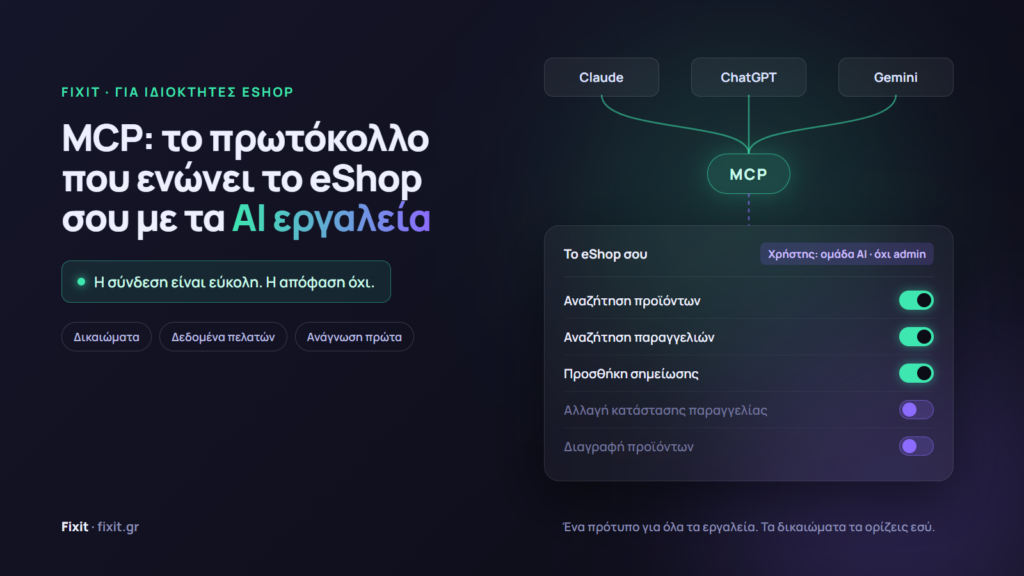
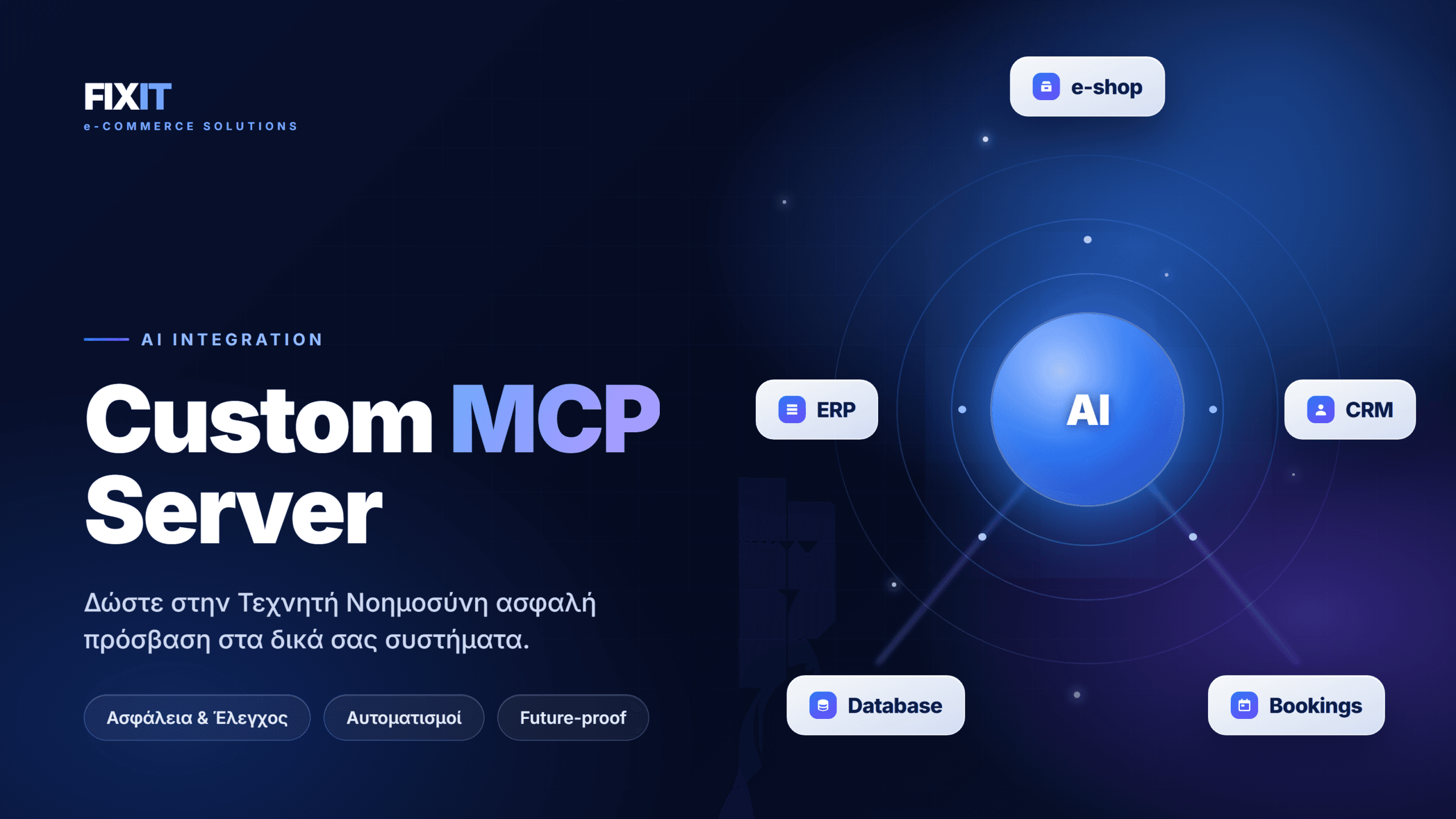
MCP (Model Context Protocol) is an open standard that acts as a "common language" between Artificial Intelligence models (such as Claude or ChatGPT) and your own systems: your e-shop, ERP, CRM, database, and internal tools.
Think of it like USB-C. Before it existed, every device needed its own cable. With a common standard, anything connects to anything. MCP does exactly that for Artificial Intelligence: instead of building a separate, fragile "bridge" for every tool, we define a single standardized connection that all modern AI models understand.
A custom MCP server is, therefore, a small "interpreter" that we build specifically for your business. On one side, it speaks the language of AI; on the other, it knows exactly how to query your system and what it is allowed to do.
Why a generic chatbot is not enough
Ready-made chatbots know a lot about the world, but nothing about you. They don't know your current stock, the wholesale prices for a specific customer, the availability of the accommodation for this weekend, or what stage order #4528 is in.
There are two ways to bridge this gap:
- Ad-hoc integrations: you build separate pieces of code for each tool and each AI platform. It works, but it breaks easily, maintenance costs double, and you get locked into a specific vendor.
- Custom MCP server: you define once what the AI can see and what it can do within your systems, and it works with any compatible model — today and tomorrow.
The difference is strategic, not just technical: with MCP you are not building for a chatbot, you are building an infrastructure.
Real-world use cases
Some examples from the field we operate in:
- E-shop / WooCommerce: the agent checks stock and prices in real time, updates customers on order status, recommends products based on history, or helps your staff instantly find "how many units of X we sold last month".
- B2B / wholesale: the agent applies the correct pricing policy per customer, prepares quotes, checks credit limits — always according to your rules.
- Bookings & tourism: availability check, price calculation for specific dates, pre-booking, answers to customer questions 24/7.
- Internal productivity: your team asks in natural language "show me client Y's open tickets" or "get me the revenue per category for the quarter" without knowing SQL or opening five different dashboards.
The common point: AI stops being "smart but irrelevant" and becomes smart and informed about your own reality.
Security and control — the major advantage
The most frequent — and justified — concern is: "will I let AI touch my data?". This is exactly where a properly designed custom MCP server shines.
Because we build it, we define the boundaries:
- Which data is visible and which is not (e.g., yes to availability, no to customers' personal data).
- Which actions are allowed (e.g., read order yes, delete order never).
- Logging of every action for full transparency and control.
- Ability to run on your own infrastructure, without sensitive data leaving to third parties.
In other words, the AI does not get "free access everywhere". It gets exactly as much access as you give it — just like an employee with specific permissions.
Where is the ROI?
An investment in a custom MCP server pays off on four fronts:
- Less time on repetitive tasks — answers, searches, reports that currently consume hours of your team's time.
- Better service — accurate, up-to-date answers for customers, 24/7.
- Future flexibility — because MCP is an open standard, you don't get locked into a single AI vendor. If the model changes, your infrastructure stays.
- Scalability — you build the connection once, and you leverage it in multiple places (chatbot, internal tools, automations) without rewriting everything.
How we approach it at Fixit
We don't start with the code — we start with what you want to achieve. Our typical journey:
- Mapping: which systems you have (e-shop, ERP, databases, tools) and which tasks make sense for the AI to take over.
- Boundary design: what it sees, what it does, what is forbidden — with security at the core.
- Custom MCP server implementation: the "bridge" between the AI and your own systems.
- Testing & training: controlled environment before production, training for your team.
- Production & support: monitoring, optimization, expansion as new needs arise.
We already have hands-on experience with WordPress/WooCommerce, B2B systems, bookings, and custom applications — exactly the environments where a custom MCP server delivers immediate returns.
Conclusion
Artificial Intelligence stops being an "impressive demo" and becomes a productivity tool the moment it gains access — with security and control — to your own data. A custom MCP server is the most correct, future-proof way to make this happen.
If you want to see where this fits in your own business, talk to us. Together, we will identify the areas of greatest value and propose a realistic, step-by-step plan.
Fixit designs and implements custom AI solutions — from smart search and automations to custom MCP servers — tailored to your systems and needs. Contact us for a no-obligation discussion.